Episode Transcript
[00:00:00] Speaker A: Welcome to the what's yous Investment Podcast presented by Ignite Funding with Ron Arceo with featured guests. Weekly podcasts that explore your time, talent and treasure, like share and follow. For more what's your investment? Let's get to the show.
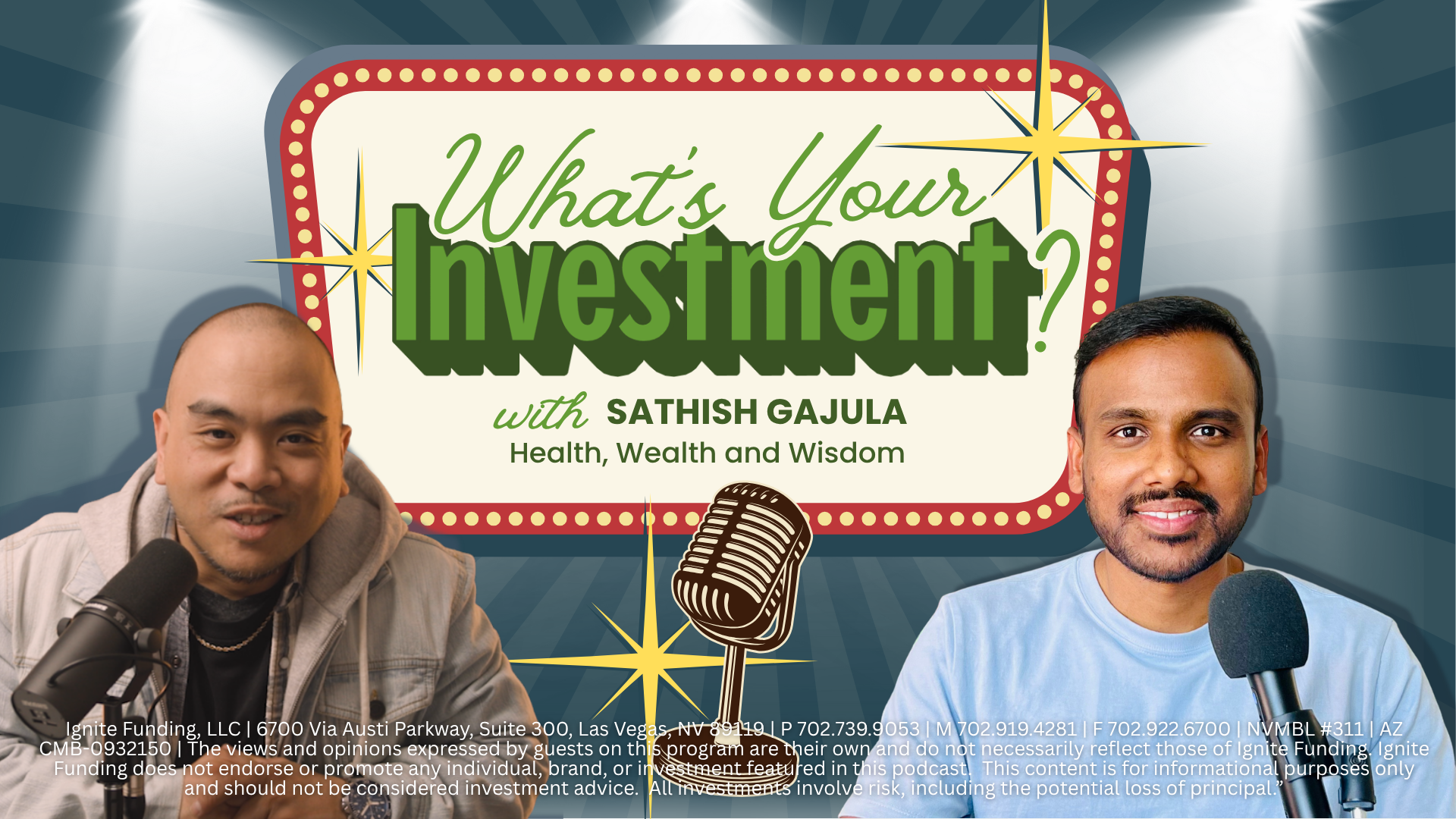
[00:00:16] Speaker B: Hey, how's it going? My name is Ronald Arceo, and welcome to the what's yous Investment Podcast. Today we're with Satish Gajala, and it's super interesting because he talks about compounding interest in so many different ways. And you'll be surprised is as to how much life you get to live when you're compounding. We'll get to that in a little bit.
Satish is a podcaster and a YouTuber. I believe he has over 50,000 followers across Instagram, YouTube, and I believe across all the premium channels. I would say his concept, or. Well, I won't even say concept. He understands the power of compounding and its impact on life, on health. We talked about that recently and obviously your wealth and your wisdom, I mean, there's a lot of things that we talked about on our pre call where we talk about discipline, we talk about things of that nature. And what I found is that through many of these interviews that we've been doing is discipline plays a really big part. So we'll get to that once we get to talking to Satish. The Compounding Project is a community again of over 50,000 folks, and it's. It's exponentially growing. And here's the thing to think about. If it's exponentially growing right now, wouldn't you be considering. Wouldn't that mean that there's a movement or a shift or something happening? Right. So before I move into just talking, I don't want to be the one talking here.
Let's bring Satish on board. Welcome, Satish. How are you?
[00:01:49] Speaker C: Hey, Ron. Yeah, I'm good. Thanks for having me on the podcast.
[00:01:52] Speaker B: Thank you. Thank you so much for being a part of this.
So let's start with just the beginning.
Who's Satish? What do you do? Where are you from?
Who are you?
[00:02:04] Speaker C: All right, yeah, I think you gave a brief intro, but yeah. I'm Satish Kajula. I'm a podcaster and a YouTuber. So I have a Instagram page and also a YouTube channel called compounding Project where we talk about taking small steps into, like, you know, there's these three pillars of life called health, wealth, and wisdom. So we take small steps consistently which lead into massive results in health, wealth, and wisdom, which. Which I consider the Three pillars of life. So over the past few years, I've built a community of over 50,000 followers on, across Instagram, YouTube and Twitter. And I'm excited to dive into the concept of the compounding and then how it impacts these three areas of life.
[00:02:43] Speaker B: I love it. Many people, you know, see wealth as a one thing. Like, it's just. It's. It's a thing you accumulate. It's something that could potentially, you know, help you in the future.
But you talk about it a little bit differently, right? You talk about it as how it compounds. So when you're. When you've created this compounding project, why. Why did you start doing it?
[00:03:08] Speaker C: All right, so first of all, there are actually two. Two reasons why I started this compounding project, right? So first of all, the first one is actually a selfish reason, because I want to learn. Like, I want to continuously learn, because there is this famous Charlie Munger quote where he said, you can't go far ahead in your life with what you already know. You have to keep learning so that, you know, you get ahead in life. That's also. There's also one more quote where he said, you know, I've never come across a wise person who doesn't read all the time. Like, none, zero, right? So these. Those two codes hit me a lot, right? Because for me, like, when I continuously learn and take action, I feel like I'm making progress. And for me, progress means happiness. So. So that's a selfish reasons, like, I want to learn. I want to keep learning, keep learning from the experts. And which is why I have this podcast where I talk to experts in these three fields. Health, wealth, and wisdom. And the second reason is actually a selfless reason, because through Journey, I want to keep posting this content online so that it will help somebody. Right there. You don't know how it will impact people. Like, the best thing about creating content online is it can not only reach your country, but, like, you know, any part of the world, right? So whenever I get messages saying that, okay, I listened to one of your podcasts and I took this. This particular action, or I started investing or I started taking care of my health, that hits me at a different level, because no money can buy that feeling. So those are the two reasons why I keep doing what I'm doing.
[00:04:38] Speaker B: So awesome. One was selfish, one was to learn, and one was selfless. One was to. To. To give, basically, right, to contribute.
I love that.
That is something I've learned. This maybe about 20 years ago, that same exact line of, you never know how far your impact will go. You never know. And I think that's such an important thing for people to understand is it's cool to not know sometimes. You know, like, if it say, for example, you have a discipline of, I don't know, contributing to charity, maybe you're doing your 10 every month or something. And like, you don't know where that's gonna go, honestly. But the. The thing that allows it to kind of release into the unknown almost is like, it's awesome. It's almost like what you're saying, right? Kind of like you never know how you're. You never know how what? You never know how helping someone, how far it could go. Right? So cool. So selfless and selfish.
How.
How has that affected the start?
You. You. You had an original kind of idea.
Let's talk about that. What was the original spark of. Of this entire compounding project?
[00:05:57] Speaker C: Oh, yeah, for sure. Maybe I'll take a step back and talk about, you know, back to 2015, where. So I came. I was originally born. Born and brought up in India. So I came to the US in 2013. So at that time, I was just following the traditional path, right? You know, go to school, get good grades, get a good job, and then live the life. So that's what I thought, you know, was the path to. A path to happiness. And so I. I came to the U.S. i did my masters, and then I got a good job, right? So in 20, I was just, you know, going to a 9 to 5 job. And then I thought I was living a good life until I got a call on a Monday evening when I was going back from work to my home. I got a call from a friend, and he said, you know, we talked about the normal things. And he said, hey, you know, do you have $380?
I want to pay my immigration fees. Because at that time, he was still applying for jobs. And then I said, okay. And then I immediately look it into my account, and I realized I had less than $100.
And I thought.
[00:07:03] Speaker B: I thought to myself, 380.
[00:07:06] Speaker C: Yes. Yeah, he asked for $380. That was the immigration fees back then. And then I realized I had less than $100. I don't know the exact amount, but it was less than $100.
So I felt miserable. I told my friend, okay, I, you know, I can give him a credit card, you know, because that's. I thought, you know, that was back then I was using credit card left and right. So I said I would give him my credit card, but he said, you know, it had to be.
It has an immigration fees and it has to be a check, you know, that has to go. And I feel so bad, you know, as soon as I went home, I did, you know, back in the day, you know, we used to use Google a lot. So I went to, you know, open my laptop and in the Google I searched, you know, how to stop living paycheck to paycheck. Because I didn't realize until then that I was living paycheck to paycheck because I was getting money. I was, you know, using my credit cards and then using my cash to pay my credit card. So I was. And I was building debt as well, because I thought, okay, if I just make the minimum payment, you know, nobody would come and catch me, right? So that, that was my mindset. So when I did, when I went and typed, you know, how to stop living paycheck to paycheck, and that's when I. At that time, blogs were a big thing. You know, reading. Reading blogs for a big thing.
So I found this. I kept on reading blogs, so about money. So this was just about money. And I kept on reading blogs and then, you know, and then the next, the next morning I just like woke up and then I was, you know, thinking about that content a lot, the stuff that I was reading. And then, you know, I thought, okay, maybe I'll just.
On the commute I would, you know, I want to listen to those. I want to read. But. Because. But I had to go to work, I had to commute. So there was this down, like time during my commute, which is like 30 minutes commute, where I was just listening to music. So I thought, okay, I'll just listen to some podcasts, right? Back then, you know, there was this podcast called Optimal Finance Daily where they used to read these blogs for us because, you know, we didn't have time back then to read, right? So that's why, okay, they should read those blogs. So I thought, okay, that was cool idea. So I kept on listening to those blogs. And then there was this one person, his name is Ramit Sethi. And then his book called I will teach you to be rich, that book kept coming up a lot on that podcast. So it's like, okay, because I'm in. I'm an Indian origin. And Ramit Sethi, he had an Indian origin. So I thought, okay, I could relate to him. And then I thought, okay, I'll just buy that book, right? So I bought that book, I will teach to preach. And boy, I finished that book in one weekend. And that's the first time I ever came across this concept of compounding. And he explained through very good example and I still think about that example today.
And that actually sparked my journey into compounding.
[00:09:55] Speaker B: Fun isn't it? Isn't it so cool? Like I've watched from it for so long and since 2000, early like mid 2010, so long I actually worked at a bookstore and I believe his books were already up there around 2008 or something like that.
That was around the time I myself, I never read in high school, really didn't like to read in college and I went to a couple seminars and one of the things that I, I remembered hearing was readers are leaders are readers, right? And I'm like, huh, let me, let me, let me take on that concept real quick. And obviously that's a very age old cliche kind of thing.
But I think there's something to be said about the things that have, like the quotes that you, you were explaining like with Charlie Munger and all that you can't get to where you want to go with what you knew is very important and being able to understand I guess at that time during the early 2000s, how especially I should say mid-2008 after the crash, I guess it was, it was something of an interesting thing to get back into.
What did you learn during this time of creating from the books to, to now, you've obviously gained a lot of information, gained a lot of wisdom, right?
I'm assuming gaming, gaining a lot of different types of wealth. Maybe you have different assets and we'll get to a little bit of that when we talk about time, talent and treasure.
What, what are some things that you have that you've done? What are some small, let's call them wealth habits.
What are some of those wealth habits that someone could partake? Well, let me backtrack just a little bit.
I remember we talked about becoming a millionaire in the, in our last call and many people aren't in that space to talk about it.
Whether it's in assets, investments or cash on hand capital, whatever it is, there's certain wealth habits that come into play to, to, to be there.
You don't have to say how much you earn or anything like that, but I'm just going to assume seven figures set the seven figure wealth habits. What are top three that you, you, you could, you could parlay into our lives?
[00:12:23] Speaker C: I love that, I love, I love that you mentioned habits because I'm a big believer in habits. And, and again there is this quote from Atomic Habits by James Clear where he said habits are the compound interest of self improvement, right? You know, like if you look at all the like successful people out there, they didn't become successful overnight. Like, you know, it all, it all boils down to that habits which they do consistently. And just like, just like that. You know, you can apply that principle to any part of your life. And when you're talking about like wealth habits, there are actually a few things that are like fundamental to building wealth, I feel like. And then those three are, I call them like Sid, like save, invest and you know, stay out of credit card debt. So these are the three fundamentals that I strongly believe in. And I first of course heard that from Ramit Sethi, right? So, so what happens is like, so I'll just, I'll just talk about this shift of mindset, right? Like before and after reading, you know, wealth books, right. Previously I thought, okay, in order to make big money, I thought, okay, I just have to just save. I mean that's the only habit or at least that's the only advice that I received growing up, right? You know, because we, I'm coming from a frugal family like you know, India. We just what I was just told, like, you know, just keep saving money and keep saving money and that's the path to becoming a like a millionaire, right? But you know, after I started reading the books, books, you know, I, I did some math, okay. In order to accumulate seven figures, let's say, you know, if you just save and not do anything like, you know, just put it under your mattress, it will take like decades if, you know, if not generations, just, if you just save money but not do anything with it, right? You know, just piling up that cash. So that I thought, okay, I just have to pile up my cash and that's it, right? You know, I'll become a millionaire, but it would take forever to become a billionaire. So and that's why I realized the first time I realized, okay, you have to invest that saving, right? So the first pillar is saving, which I think it comes frugally to me but it natural to me because of the way I was born and brought up. But I feel like we can get into the stats later as to how to improve savings and stuff. But yeah, so the first pillar is savings and then the second one is investments.
So, and also this investments. I think so many people are scared to invest like, you know, in not only in stock market but real estate and all that stuff. They're like Scared to invest. And that was my mindset. Right. You know, so also like why, why do you think? Exactly. So, yeah, so, so we, you know, growing up, so we, we used to watch, you know, at 9pm there is this show called, you know, Global News. Like, you know, they used to talk about all the stuff that's going on in, in the world and then towards the end they just talk about the stock market, right? And the stock market like just talk about like, you know, this India, we have like Nifty50 and Sensex. They talk about like, you know, how the index went up or went down. So looking at those news and coming from my parents also, they said it's always, they make you feel that okay, it's risky. Like you know, the stock, people are losing money in the stock market and it's, it's like gambling, right? And then whenever I used to ask my dad, he said, you know, stock market is risky. He has never encountered somebody who made money in the stock market. So I thought, okay, that was ingrained in my mind. So I thought it, it's like, you know, I thought it was gambling, I thought it was risky. So I didn't want to lose my money, right? So that, that was my mindset before reading all these books. And with that mindset, okay, I, when I started reading those books, I think if you, if you boil down to fundamentals, it's actually stock market is one of the safest places over a long term. Like you know, when I say long term, like maybe 20, 30 years, it's actually safe, safe place because there are, if you look at the past data like there has never been a 20 year period where you lost money in the stock market, right. Isn't that amazing? Like you can take any 20 year period in the past, let's say like 210, 220 years. There has never been a period with lost money in a 20 year time period. I know some people say okay, 20 years too much. But again like you know, it's harder than, it's easier than like working until like 65, 70. Most people don't even have money to retire when they're 65. So I think you know, in wealth building, wealth building is a long term journey. So I feel, yeah, so that's important to have that long term mindset in mind. And then so first habit is saving. Second habit is investing. The third habit is debt. So the, especially credit card debt. So I, I mean just like I said, I used to spend a lot of money I was making in 2015 and then it was like mostly with credit card spending. So I thought like credit card was free money because, you know, the first year you get 0% APR, you don't have to pay any interest. Right. And then I was just using this, using this as free money. And then after I read these books, you know, after I did my math. So you can use like compounding to make money, like become wealthy. And you know, for credit cards, it's actually compounding is working in the negative direction. Like it's negative compounding because you know that interest that you get on credit cards, it piles up, man. Like, you know, boy, just do some compounding calculations on this credit card with all those like high interest rate, like 20%, 24% APR.
It's actually like, you know, you're digging your own grave. Like, you know, if you're into that credit card debt. So my, I mean it's not that I don't use credit cards, but I use credit cards. I mean I do travel hacking, gain points and miles, but I paid month, month by. There has never been a period where I paid a single dollar in interest in the past 10 years. So that's how I look at like, you know, saving, investing and staying out of debt.
[00:18:26] Speaker B: I love it. I think there's, there's so many different little bits of nuggets and little bits of information and wisdom there.
Saving, investing and, and staying out of crazy debt is, is, is, is almost like the key to almost a lot of things. And then I guess the other caveat is, is depending on the, how you're using debt, I suppose too, right?
[00:18:47] Speaker C: Yep.
[00:18:48] Speaker B: That's not a conversation for this.
But if you're looking for points and miles, I mean there could be, that's, that's a different conversation, a different, different type of situation altogether. But if we're talking about building wealth as a long term play.
Right.
Because many times people are just kind of doing the short term play. You kind of just said it like people have a hard time thinking about, you know, their retirement like at the end of it. Most people, most people don't have it. I'm young enough to not be in retirement yet, but I'm sure you and I probably both know that there are parents of ours or friends of parents or uncles and aunts and everybody that, that probably are in a situation where they are retired and are struggling to make ends meet.
I think we all go through stuff like that. And the challenge is no one's taught us about any of these things. No one's taught us how to use a credit card wisely at 18, they're kind of like, here's your credit card, I remember.
And you know, it was, it's interesting now because looking at, looking back on, was very negative compounding. It was very much in the negative compound thing.
So 20 years, you're talking about like, like an index. I, I suppose. Right. If you're, if you're doing the S and P for 20 years, you could probably, it's a, it's a safe bet to say, and I use quotes on that to say that you could probably get your 8% over, over time, which is great. I mean, that's the long term play though. And like you said, and I think research does back this up because I've, I've done a little bit of research myself on the S and P and, and how, how long the periods are between either a correction or a gap in terms of the, the, the loss of investments over a certain amount of time. I do think seeing things over that amount of time is very beneficial. That many people probably don't really realize is that if you're in it for 30 years, your money's gonna go up. Right.
I know our CEO, she talks about, our president, I should say. She talks about how if you were to put something in a, you know, let's say you have kids and you put $10,000 in there and you just let it ride until they reach retirement age, they'd be a millionaire without touching anything, which is amazing. Right? Like you don't have to do anything, pretty much, which is cool.
So you have a, a steady stream of followers and you're helping them develop these small, consistent financial wealth habits. Right.
What's the philosophy behind it? How do you, how do you approach investing in that sense if, if you're saving. So we talked about saving.
It was a natural. It was, you were naturally frugal at it because of the way you live.
Maybe you can give me something on that. How can. Maybe from just experience alone. What's one thing that people could do to be a little bit more frugal in their lifestyle? So they could save?
[00:21:56] Speaker C: Yes. Yes. So, yeah, that's actually a good question because I've been, whenever I say this, like, you know, I'm an, I'm a natural saver. So many people say, I mean, it's very hard because, I mean, when I came to the U.S. you know, the first thing I realized was like, you know, whenever I went to Walmart and then I saw all these like Giant, you know, chip and Chip, you Know, this, what do you call this, processed food, right? You know, giant Coke bottles, giant chips bottles. Sorry, chips packets and all this stuff. They were like huge, like jumbo size. And, and that was, that was like normal, like that was like a regular size, right. Whenever I had asked for coffee in India, like, you know, you get a very small cup of coffee, but here, you know, like, if you go to Starbucks, the small one is actually like, I would consider an Excel in India. So like, if you, like, you know, I think this, in this capitalist economy, like, we are. The reason why I'm saying this, like, you know, in this capitalist economy, we are bombarded with all these, what do you call, environmental habits where, you know, you are prone to spend money, right? Because in this, in this economy, right, you know, everybody wants your money, right? So that's how, that's how, that's how this system is set up. Exactly. That's how this system is set up. Like, you know, nobody wants you to save. Like, you know, everybody wants your money. And then if. So, if you're not being cautious, right? You know, it's easy to, easy to overspend. So. So I think so whenever. So I'm, look, I looked at some stats before we hit record. There's actually like more than 50% of people in the US they can't even afford a thousand dollars emergency, right? So, so which actually it's, it's, it's scary, right? Because, you know, wealth, like, you know, money touches almost every part of our life and then we still don't touch, take care of that money. And it's actually, if you boil down to these fundamentals, it's, it's, it's simple but not easy. Like it requires some discipline. So, so yeah, when it comes to like some practical ways to save, save money. So I read this book called Millionaire Next Door by Thomas Stanley. And that book, that book actually opened my eyes when it comes to who the actual millionaires are. Because, you know, I thought, you know, growing up, I thought, okay, people who had like big, big mansions, big cars, you know, big vacations and all, all these people, they were rich people. But it's actually like, you know, Morgan Housel says like, wealth is what you don't see, right? You know, if you, if you spend, if you spend that money on a bigger house, on a bigger car, on your vacation, it's all gone. Like, it's not helping you to build wealth. So, so that's why I try to look at these top three things that is actually, that'll actually move you move the needle. Like, you know, I. So when it comes to the, like, expenses, the top three things that are sucking money, like, you know, sucking money out of your monthly expense are like, you know, your housing, food and transportation. Like, these. These three things. And, and if you really think about it, at least for me, like, you know, this. Housing and transportation. Right. I was just there. Is this term like, you know, keeping up with the Joneses, right? I think so. That's the. That's the first thing I heard when I came to the U.S. like, you know, keeping up with Jones, you know, that was. That was a term.
I've never used it back, back, back. Back in India. So. So. So we are trying to actually, like, if you really think about it, like, you know, when I. When I graduated, like, when I got my job, I'm glad I read these books. Otherwise, you know, I would have bought a luxury car for myself because I thought, okay, that's. That's the dream, right? You know, keep up with the job. Exactly. Exactly. That. That was my mindset. But I read that book and I thought, okay, like, you know, if.
Right. You know, you can still do the thing that you want to do. Because for me, like, you know, I didn't need a luxury car like when I. When I graduated and got my first job, because for me, car was just like, you know, to go from point A to point B. And I have a Toyota Camry. I've been using it for the past eight years.
[00:25:52] Speaker B: It's.
[00:25:53] Speaker C: It's, you know, I don't regret that decision at all. So it's like, you know, when we actually align our spending with our values, that's where, you know, I feel like the saving picture comes in. But, I mean, if you really want that car, just go get it. But, you know, you have to, you know, cut down on something else that you don't need. So this book, like Ramit Sethi in I will teach you Bridge, he said, you know, spend extravagantly on things you like and then cut costs mercilessly on things you don't like. Because, you know, most people, they just spend money just to look rich. But it's actually, you know, if you.
If you just align your spending with your values and then try to save, you can actually use those savings to build a significant amount of wealth. And those are the big three things, like, you know, housing, food and transportation. So housing. I used to stay with roommates, right? I mean, now I have a family.
I've recently bought a house. I can explain, you know, what the decision behind buying a house now. But yeah, so it's housing. Like I used to stay with roommates or I, I didn't actually for the past, for the first eight years of my wealth building journey, I was paying less than thousand dollars in rent. So you know, I was, that was one area I tried to optimize because of these three things like housing, food and transportation. Housing is the biggest expense. Like you know, 30 to 50 sometimes like some people have even like 80% of their spending on house which is actually like, you know that's so that's a lot of work. So that's why like you know. Yeah, so that's housing and then like cars. Like I mean if you're a little bit smart about cars, like I, I, I, I'm okay with like driving any used car, you know, which is like two, two to like five years old. It's like the first, the moment the car comes out of the lot, it loses value, right? You know 20, I believe like 20 right off the bat, right? If it loses value. So yeah, I'm okay with driving you know, a two to five year old car which it, it, you know, it's still good to where I want to go. And then when it comes to so housing, transportation, then the third item is food. So I used to eat out a lot, right. And there are so many examples where you know, if you take just one, that Starbuck coffee every day, which costs you like you know, $5, $10 and use that amount to invest and then turn to huge, huge amounts. But again like if you really love that Starbucks coffee, go get it. Like, you know, I'm not telling you to not spend on what you love but actually be smart about it. Like are you really spending, you know, align with your values or are you just spending just to look rich? And you know, there's this quote, I think it's like big.
Sorry, like big hat and no cattle. Like you know, people just look rich but they don't, they don't actually, you know, are rich. So yeah, these are the three buckets like you know, that you can save to, you know, basically maximize your savings.
[00:28:50] Speaker B: It's, it's great housing, food and transportation. I agree.
Yeah.
Just, I was just doing my budgeting earlier today and I was like, oh yeah, I'm about 25% of my house, 25% of my income. I'm trying to, I mean this kind of. And then I got a 10 year old car. So it's like I'm trying to. And I looked at new cars so There's a bunch of people here in the office that got a bunch of new cars recently or slightly new to used cars.
Those new cars are expensive.
Holy smokes. What happened? Like, a Minivan is like $75,000 at this point. Like, what happened? What happened?
[00:29:30] Speaker C: That's true. Yeah, I mean, like, you know, cars. There is this. I listen to Choose a five podcast a lot. Then the financial independence community, there's this calculation where, you know, if you keep buying new car every like three years or five years, if you keep doing that, versus, you know, if you just bought a used car and, you know, held on to it for like, let's say 10 years, and then for every 10 years you buy a used car, right. The difference is actually close to million dollars. Just that one decision.
Right. You know, maybe I can, I can send you that podcast, but, you know, that difference is close to a million dollars. So you can imagine, like, you know, how other things can actually, like, compound. So actually, like, you know, just to add to what I said on housing, food and transportation, like, you know, if you, if you take care of these big things, right, like this, this big rocks that actually move the needle, you don't have to sweat too much about the small stuff. Right. You know, I've seen people, like, where, you know, they live in, like, big houses, have luxury cars, but they still, you know, do coupon clipping and then try to find the best deals on this $10, $20 stuff, right?
[00:30:37] Speaker B: Yeah.
[00:30:38] Speaker C: Yeah. So, so that's why, like, if you, if you take care of the big rocks, the big stuff that move the needle, you don't have to sweat about the small stuff and use your time in, in. In a better way. Right? So that's, that's my mindset.
[00:30:47] Speaker B: I love it. And you're relating it back to time now. So that's money time. You know, being able to spend it wisely gives you a more, let's just call it a quote unquote, richer life, being able to spend it wisely. I got a few more questions.
You have a podcast or you've been on podcast as well.
What were some of the things that you were. That. What's, what's one thing? And then I'll get. I have a few more podcasts and we have like 20 minutes left.
What are some of the things that you could say influence your own financial decisions? Maybe just one or two things.
[00:31:27] Speaker C: Yeah. So for me, so one financial decision significantly. So recently, I've actually. So I've always been a fan of index funds, you know, for the past, since 2015 16, I've been investing in index funds. So it's mainly either S&P 500 or a total stock market index index fund. So those two are the funds where I, like, 95% of my money is in. So I still do, like, you know, 5% of my money is for, like, fun money where I do Bitcoin, Ethereum, and some individual stocks. You know, I don't have any data to back that, that 5%. You know, I don't know how much return I would get on the 5%, but I'm like, okay, that's my play money. Even if I lose that money, I'm still okay. But, like, 95% of my money is in either an S&P 500 or a total stock market index fund. I usually recommend Fidelity, Vanguard, Charles. I don't use Charles, but like, yeah, Vanguard and Fidelity are the companies that I usually invest in.
Right. So lately I've been. I thought, you know, that was. That was my path to financial independence. So lately I've had a guest. His name is Paul Merriman. Paul Merriman. He's. He has this foundation called Paul Merriman Financial foundation, where he had, like, lot of data to back up. Right. You know, if you add maybe one fund to that portfolio, he calls it like small cap value index. So if you add small cap value index to your, let's say an S&P 500, you can beat the market. It's basically not beating the market, but maybe you can get maybe 0.5 to 1% higher than what you currently get with an S&P 500 fund. For example, let's say if a S and P finder fund returns 10% per year, like adding small cap value index, you could get 11%. And you can, you can imagine, like, you know, over a long period of time, that 1% is huge. It makes huge difference. So. So that's something. I looked at the data and I spoke to him. I even met him during a fincon. Paul Merriman. And then I recently added small, like slightly, maybe like 10% of small cap value index. So. So that is one thing that I learned podcasting. But again, like, I'm a huge, huge believer in index funds. I. I realize the importance of, you know, index funds. I don't do too much of real estate because I. That's not my expertise. I mean, I've been doing stock market investing for the past, like, 10 years, and that's where I feel comfortable. And also, I know the data.
I read the data.
[00:34:02] Speaker B: Yeah, it's fun. I don't, I don't involve myself in too much of the financials and out there. Well, I do, but I don't really divulge it. But just, just knowing how index funds work, it's, it's a great, it's a great, it's a great vehicle in my opinion.
Almost hands off in, in, in many different ways and just gotta keep putting it in. That's, that's kind of, that's kind of how it is. I mean the whole idea of dollar cost averaging and just contin Consistently consistency and discipline, I mean that, that lays out in everything in life, right? So you're talking about health, wealth and wisdom and how doing all the content, being on guests, podcasts, being on shows, you've learned a lot. Read the books, you've learned a lot. Built about, built, built a bunch of different wealth habits and put those into place. Where are you now in life? Like, where are you? Like, how has it been now compared to.
Better question.
If you could tell yourself one thing 10 to 15 years ago, when you first, I'm assuming you first got here 15 years ago, right? Just about 10, 15 years ago.
[00:35:14] Speaker C: Yeah.
[00:35:15] Speaker B: Would you tell yourself?
[00:35:18] Speaker C: Yeah. So for me, like, you know, after I looked at the compounding equations and compounding graph, you know, the biggest thing that can move the needle is starting early. Like that's it, like period in any area of a life. Like, it could be like, you know, your health, your wealth, you know, it could be wisdom. Like starting early is a key. I mean, I started age 25. All this journey at age 25. Like if you'd asked me, like, you know, one thing I would have done at age 25 is to even start earlier. Right. I wish I had known this concept like growing up. That's why I, I talk about this stuff a lot. So that it could reach. Maybe there is a, There is a 10 year old out there or a 15 year old or a teenager out there who's looking at these concepts and who is taking that first step of action. Because you don't have to, like, if you really have that time on your side, you really don't have to take huge, huge, you really don't need huge money to become wealthy. Right? There's, there are some calculations where, you know, Paul Merriman, my guest, he said, you know, when a child is born, if you just invest $1 per day, like one, just $1 per day, which is $365 per year by the time he's 65. He or she is 65. They'll have more.
More. Close $2 million just for $1 per day. Close $2 million. Isn't that.
Yeah. So this time in the market is more, more important than just like timing the market. Right. You know, which way, when to buy, when to sell. This is a famous Jack Bogle quote. So, yeah. So, yeah, to answer your question, yeah, okay. If I had known this before, I would have invested in my health, I would have invested in my wealth and wisdom a few years more. Like, you know, that would have, I would have been a very different position right now. But again, I don't want to cry over the spilled milk. I mean, I think people have to go through that journey to understand the importance of like, you know, people say, like, you know, you can only appreciate the, the light when you see the dark. Right. So, yeah, I've seen that. You know, that paycheck to paycheck, that kind of lifestyle and also my health not. Which is not in a good shape back then, so now and appreciate my health, appreciate my investments and all that stuff. And then I don't want to go. Go back to that person anymore. So that's where like, you know, which actually drives me.
[00:37:30] Speaker B: Yeah.
[00:37:30] Speaker C: So, yeah, if there's some time, I would have started early. But again, like, no regrets there.
[00:37:34] Speaker B: So you would say that appreciating yourself, appreciating your, Your time, appreciating your, your, your. Your seeking of financial understanding, appreciating all of that allowed you to appreciate in, in, in another different way, appreciate the, Appreciate the, the value of the investments you've made over time in yourself, in your health and your, in your wealth and in the mindset. So. Okay, cool.
I love that. I love the fact that time in the market, and I remember Jack Bogle saying it as well, time in the market is better than timing the market. I'm paraphrasing.
But yeah, it's, it's.
I think that's a big thing. I wish I started early. I think I said that on the last show, last episode. I wish I. That should be the name of the show. I wish I started earlier.
Then we'll get the right people here listening. No, I'm just kidding. You are doing a fantastic job. And I would say creating content around financial education, particularly as someone new to the country even, and learning how to build that and create a life where most people that have been born here wish they had.
And so creating content around this I find very interesting. I find it super cool that there are, there are More people creating content around that. I want to ask you a couple more questions around that, around the content creation side of it and, and what you could possibly give for advice for, for some beginners and other creators in the space doesn't have to be finances, but just in general, what have you or how has the content around wealth, the stuff that you've learned as well, shape the understanding and your discipline around money?
[00:39:30] Speaker C: Yeah, so that's a good question, actually. So the understanding about, you know, investments and money. Right. So for me, I just to back that up. Back, back up a little bit. So I want to talk about, like, why. Like, you know, because most people, you know, there's also a code that says if you have a strong why, you'll figure out the how. Right? So for me, like, you know, when it comes to wealth, the why part is freedom. Because, you know, the best thing money can buy is freedom. Right. You know, some people ask me, like, you know, why are you so frugal? Like, you know, why do you keep saving money? I'm like, no, I'm actually saving money to spend, right? To spend on my freedom. So that's, that's how I look at it. Like, you know, so I have this financial independence number. I'm looking, we are looking at like $2.5 million. That's a goal. So that's like, you know, and that. So, so that's my financial independence number where, you know, once I hit that number, my finances, like, you know, my investments will take care of all my expenses. So I don't have to, I don't have to work. I mean, I, I can only work on what I need. Right. You know, what I want to work on. Right? So that's, that's the mindset behind it.
So, so to answer your question on, like, you know, how investments and like this money actually. Can you, can you repeat that question? Maybe we can.
[00:40:49] Speaker B: Creating that content around wealth shaped your own own understanding and discipline.
[00:40:56] Speaker C: Yes, yes. So actually, so, so creating content is actually, I would say it's. It's difficult in the beginning, but it actually just held me accountable.
Right. You know, exactly, exactly. Like, you know, when, let's say, you know, when you say that, okay, you know, you, you got to be consistent. You got to take action and, you know, you got to start investing. But if you're not doing it right, how can you teach somebody or tell somebody to do it? Like the same thing. Right? You know, when it comes to, like, health, like, you know, let's say if somebody has, you know, he's in a bad shape, and then he doesn't have his health in our control. And let's say if he tells you to, okay, just go get that body and, you know, be consistent. All that stuff. Like, okay, if that's the case, like, why you're not doing it, right? That's the first question we ask, right? So that's why, like, you know, so creating content actually made me more accountable. Like, I mean, I'm not. Again, like, I'm not. I'm human. I have emotions and I keep splurging on different stuff, but it's just that whenever something happens, I always come back to basics. Like the basics that we talked about, like, you know, saving, investing, and staying out of credit card debt. So these are the basics that I come back to always. And creating content has made me accountable.
Right? And so I.
It also gave. Gave me some clarity on, like, you know, what the next few years are going to be. Because, you know, people say, like, you know, okay, you can only learn so much by just reading. But, you know, you. You can learn a lot by actually teaching and applying that in real life. Right? So, so when I create content, actually I found these concepts to be, like, fundamental. Like, I thought, okay, before, like, started creating content, I thought, okay, there's always something new that I have to, like, chase. There's always something like new technology or like, blockbuster stuff that's coming out that I need to be aware of. But it's actually like these fundamentals, like, I keep talking about the importance of this fundamental, like sticking to the fundamentals and keep repeating it. The time will, you know, will magnify whatever you're doing, right? So that, so that's something like, you know, this clarity and also accountability is something that I actually developed. You know, creating content online.
[00:43:07] Speaker B: Clarity and accountability. Those are some of the biggest words that we could implement into our lives is find the clarity of where we want to go and then finding somehow to stay accountable to it. I find that cool that you actually use content to create accountability for yourself. That's pretty interesting.
[00:43:24] Speaker C: Yeah, for sure, for sure, for sure. Because anyway, I feel like, you know, knowledge is just not enough. Like, knowledge is not actually power. Knowledge is potential power, but it's actually the application of that knowledge will give you that results. Right? Because I, back in the day, I used to be in the mindset that, you know, I just have to keep learning, keep learning, keep learning, but not take that first step of action.
Nothing changes, right? I mean, you can, you can spend months, years, or decades just Learning, but you don't take action, you know, you can't go far ahead. So that's why like, you know, it keeps me accountable to take action and, and then, you know, make, make progress.
[00:44:05] Speaker B: I love it. Yeah, it is a.
What is it?
Someone said it, knowledge is power, but really it's potential power because you have to take actions to apply this knowledge. And I believe that very true. Because you can have all the knowledge in the world. I worked at a bookstore because I wanted all the knowledge in the world. Literally I have that written down as a goal. Was like I wanted to learn more. So I'm going to surround myself in the environment that I needed to.
But it was learning for learning sake.
The only time I took an actual action step was at that point. I became an author after being a bookstore person.
But I had to take the action to it and to write a book, you know, takes a while, but takes some accountability. Takes some clarity and discipline to get it through. So I'm finding this all very interesting because it's fundamentals that we need to stay in practice with. Okay, so final questions and we could do this rapid fire.
What do you invest your time in currently?
[00:45:08] Speaker C: So yeah, I'm always looking into like three pillars of life. Like because I feel like those are fundamental. So health, wealth and wisdom. So these, these three things. So I, when it comes to health part, there are three habits that I always like double down on. It's actually like nutrition, exercise and sleep. So these three are for me, like, you know, are the fundamentals when it comes to living a healthy life. And then I try my, my best, you know, to optimize these three areas. And that's where I feel like, so the why behind my health is like, I feel like health is the foundation of everything. Like, you know, there is this quote which said, you know, a healthy man has thousand wishes, but a sick man has only one wish like his health, right. So that's, that's the only wish. So, so I, I thought, okay, there is nothing else matters if you don't have your health. Right? So, so, so that's why I've been doubling down on my health. So I invest my time in again using the principle of component, like taking small steps, you know, trying to become one person better in these three areas. Like you're dialing in that nutrition. You know, when it comes to exercise like lifting weights and doing some, some endurance stuff and sleep, like I have to completely underestimated.
I'm going to say that again. So I completely underestimated the power of sleep. Until I read a book called why We Sleep by Matthew Walker.
I tried to optimize it and yeah, I'm loving it. So that's where I spend most of my time when it comes to health. And then, so when it comes to money, I think that's one of the only few areas where, you know, you don't have to spend too much time. Like, you know, I automated everything. Like, you know, my paycheck, whatever the money comes in, my savings, my investments, everything is automated. And the best thing I can do for my wealth pillar is not to do anything. Like let the automation run and then, you know, in, in a few years I'll hit my fire numbers so I don't have to mess up my portfolio. And that's the best thing that I can do, like, is to do nothing, just let it run. So that's when it comes to like wealth and when it comes to wisdom. Like, yeah, I invest my time in three, three habits, which I call them, like you know, reading, meditation and also journaling, like these three habits. I, I mean I didn't end up, you know, with these habits like overnight. Right. It's actually a 10 year process where I, I tried a few things and then these are a few habits that I, I feel like I, I, I stuck, those habits stuck with me.
And so yeah, those are the, like, I would say. So if you really think about it, there are like three habits for each pillar. Like three habits on health, three habits on wealth and three habits on wisdom. So that's where I've been spending most of my time.
[00:47:56] Speaker B: I love it. Yeah, your sleep for health. At least it's, it's nutrition, exercise and sleep. And I find that so cool that sleep is, we need more sleep, everybody.
Wealth saving, investing and staying out of debt or as best as you can.
And then with the wisdom, reading, meditating and what else do we have? Journaling.
Oh man, it's so cool that like the fundamentals are, are pretty much the same all the way around. And I think there's a reason why it's that for everyone that kind of come, that kind of gets into this space and frame of mind because it is true. And with that being the case, you're, you investing time in all those areas. What do you invest your talent in? What kind of talents? Hidden talents, maybe you got, I don't know. What talents do you invest? What, what do you invest your talent in?
[00:48:48] Speaker C: So, so for me, like, yeah, I, I would say I'm, I'm not, I mean, no Close to like being super talented in any, any of these areas. But for me the biggest thing I feel like I'm good at when it comes to talent is like being consistent. Like that's, that's something that I always like fall back on because.
So there is this quote from Chris Williamson.
I know I keep saying a lot of quotes, but I just love quotes because we can boil down big concepts into a simple conversations. Right?
Exactly. So he said, Chris Williamson, he said.
So being consistent or may not guarantee success. Being consistent may not guarantee success. But being not consistent will guarantee that you're going to be unsuccessful. Like that's it. Like you know, it's, it's, you know, you. Have you ever seen a successful person who just like you know, did it for once and then have, has never done it again? Like yeah, it's, it's very hard to find. Right. So it's all like boil downs to. Boils down to consistency. So that's one thing I feel like, I feel like I'm, I wouldn't say talent but I think I, I'm good at like being consistent. So you know, I can, I feel like, you know, if there is any like noise out there, I can boil down to like these, these fundamental habits that I talked about and then being consistent with it. Like you know, it's all like for me, like, you know, I always used to chase perfection. Like previously before knowing all this concept, I used to chase perfection, let's say for, for a workout, you know, the perfection was like, you know, to get one hour of workout and then for me if I didn't have one hour, I would, I would skip the workout because I was like, okay, what, what happens? Right? But now even if I don't have time, I'll still do a five minute workout. Like you know, for me that's, that's a success. So because I focus, I focus on progress over perfection. So, so yeah, to answer your question, like you know, yeah, my talent is, I feel like, yeah, being consistent and then let component do its magic. Let you know, give it enough time and then have compounding take care of the rest.
[00:50:53] Speaker B: Love it. Progress over perfection. I enjoy that.
Awesome.
[00:50:58] Speaker C: Cool.
[00:50:59] Speaker B: And so final question.
Treasure. What do you invest your treasure in? It could be family, could be anything, could be whatever you decide. It doesn't have to be money or anything but what do you invest? Your treasure?
[00:51:12] Speaker C: Yeah. So I, so if you know, for. The most obvious answer for me is like, you know, when it comes to like money, I invest in you know, index funds which I already talked about, like lately I've been investing a lot in relationships and networking because I understood the power of networking in the past one, one year or so and I've been doubling down on it. And I believe that this kind of conversation that we're having is due to the networking. Like, you know, we have been to the fincon, like financial conference and then, you know, it opened up this door. Right. So, so that's one thing. Like you know, it. I read somewhere that, you know, it's not what you know, it's, it's who you know or somewhere along those lines. Right, so, so, so yeah, is your net worth. Exactly, exactly. So that is something I've been like trying to invest heavily on, making those connections because ultimately in this world of AI, a lot of stuff can be replaced. But these human relationships, I don't think it can be replaced. This one on one human connections and networking, it's very hard. So that's why I've been doubling down.
[00:52:15] Speaker B: I agree. I've been saying the same thing for the last 15 years, that the human connection is so important that we shouldn't let it, shouldn't let it die down.
With all the tools that are supposedly supposed to make our life easier.
I find it actually being a little bit harder to get things done, to make things like I have more stuff to do actually because of AI, which is, I don't get it. And I thought technology was to make it all easy.
Awesome. So cool. I've had a great conversation with you. It was a good, good, solid, very unique conversation.
I loved everything that you went over from the books that you've read, the people that you've met that have mentored you, the, the, the things that you're investing in. Treasure, time, talent.
It's awesome to hear where, you know, where people come from, at least for me. And so I appreciate you taking the time, having listeners listen to you and, and take the time to hear where you're coming from. And like you said, you never know where or like others say, you never know how far this impacts will take it, it will take and how far it'll go.
So I appreciate you taking the time for this. Is there anything that you'd want to tell anybody listening now before we head off?
[00:53:32] Speaker C: Yeah, one thing I always tell my followers and also my audience is just start, just start and then just be consistent with it because, you know, I mean, we can have, with like we discussed, we can have all the knowledge in the world, but it's almost useless if you don't Take action. So for somebody who's listening to this, just you know, take you know one one learning that you learned during this podcast conversation and take action on it. Like you know it doesn't have to be big steps, small step in a component. Over time it will turn into massive result.
[00:54:07] Speaker B: Love it. Awesome. Thank you Satish Everybody Join in the Compounding Project. Follow Satish on YouTube, on Instagram, on Spotify, check out the blog I think it' compoundingroject compoundingproject.com and catch up on Instagram Compounding Project with with the sign.
I'll have the team reach out to you later and have everything set for you so that you could release this to your audience as well. For everyone watching and participating in this, thank you for attending this episode of the what's your Investment series. Or what do we call it? What do we call it? Earlier Time. What do we say?
I I made a new title. Somebody's going to chime in in the beginning of this and give me this in the comments.
I appreciate you all take care. Thank you Satish. See you guys soon.
Hey, thanks for watching the what's your Investment podcast. Please like follow and comment. And don't forget, check out our other videos. We got the Deeds in the Desert and the Day in the Life episodes. See you there.
[00:55:10] Speaker A: Thank you for tuning in to this episode of what's yous Investment, brought to you by Ignite Funding. Don't forget to like, comment and follow for more. Check out our other podcast, Deeds in the Desert, and let us know who you would like to come onto the show. We'll see you next week.
The views and opinions expressed by guests on this program are their own and do not necessarily reflect those of Ignite Funding. Ignite Funding does not endorse or promote any individual brand or investment featured in this podcast. This content is for informational purposes only and should not be considered investment advice. All investments involve risk, including the potential loss of principal.