[00:00:00] Speaker A: Welcome to the what's your investment? Podcast presented by Ignite Funding with Ron Arceo with featured guests. Weekly podcasts that explore your time, talent and treasure, like share and follow.
[00:00:11] Speaker B: For more.
[00:00:12] Speaker A: What's your investment? Let's get to the show.
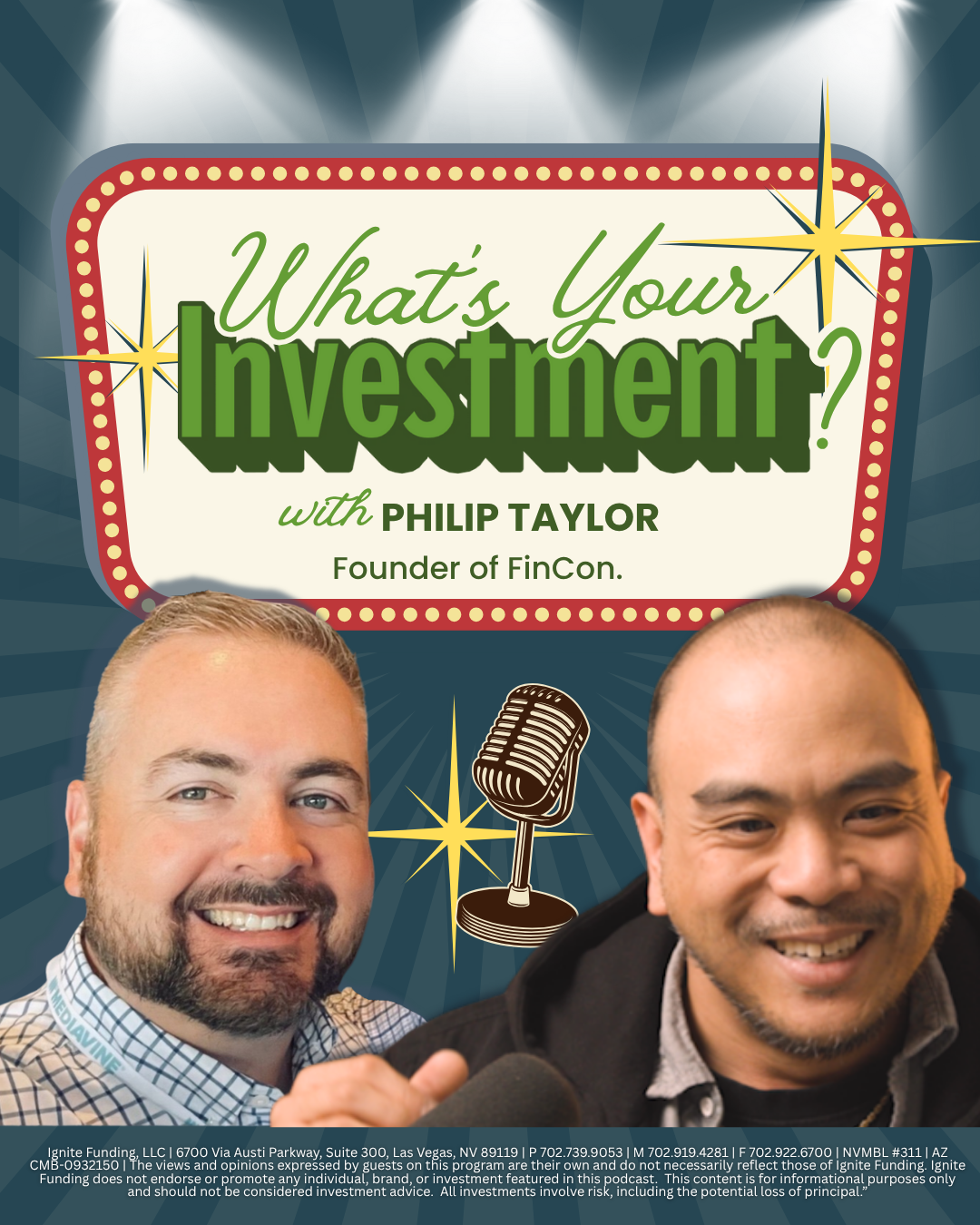
[00:00:16] Speaker C: Hey, how's it going? What's up, everybody? My name is Ronald Arceo and welcome to the what's your Investment Series podcast. It's. It's a thing I got. I got someone pretty special here. He's been doing this for a very, very long time. He's the founder of fincon, Been in the personal finance creator space for quite some time. He runs the creator cpa, the pretty much a firm that's dedicated to helping content creators manage their accounting and taxes, which is quite a bit. If you're a content creator and you're making a chunk of money, there's a lot of things underneath that that you probably should be looking into. Without further ado, let's welcome PT on board. Pt. How's it going, Ron?
[00:00:55] Speaker B: It's going great, man. It's really a pleasure to be on here with you.
[00:00:58] Speaker C: I love it.
So for the people that don't know you, who are you? What do you do?
[00:01:03] Speaker B: Yep. Philip Taylor. You said it. Cpa.
I have a CPA firm. I live in Texas, three kiddos and a wife. And I also have run conferences through the years. You mentioned Travelcon and Fincon, and Fincon's the big one that I started back in 2011, so that's kind of probably defined my career. Mostly spend some time in public accounting, enjoy golf and just generally enjoy business and. And, you know, try to try to move my life forward, I guess, every day.
[00:01:37] Speaker C: Moving forward every day. They say progress equals happiness.
[00:01:39] Speaker B: Right?
[00:01:39] Speaker C: And it is something that we. We definitely want to move towards. I guess most everybody wants to move towards pleasure, away from pain, I suppose.
What is your. So you started out in the blog space. We talked a bit earlier. You. You. You started on the blogging space.
Why? Why. Why there? Or actually what started you off in that space?
[00:02:03] Speaker B: Yeah, so I guess I came along at the time blogs were taking off. Right.
Meaning I got out of college and had a corporate life, but was curious about the Internet and had played around with building websites and doing marketing online just a tad.
I was interested in running at the time, so as a way to kind of journal what I was doing with my running, I started a blog to kind of share those notes and talk about my races, talk about things I was doing. It was a lot of fun.
And little did I Know, that sort of passion for blogging would collide with my passion for personal finance at some point. And that would ultimately lead me to start a personal finance blog where I really, really dove into doing it full time.
But so, so it was one part, I guess, being in the age of the Internet and wanting to participate in that and then one part finding the subjects that really gave me a voice and gave me something interesting to share. Right. So I was reading these blogs, running blogs, finance blogs, and really just loving what I was consuming and sort of a behind the scenes, chronological story of what someone was doing with their life. And I was attracted to that. These people were, you know, moving themselves forward every day. And so I wanted to kind of showcase where I was going with what I was doing. And so that's probably what ultimately attracted me to blogging was just the idea of documenting sort of what was happening in my life. And of course I saw people, people taking blogs into more of a business realm where they were making it, you know, something they were doing as an entrepreneurial endeavor.
I had always sort of thought I'd probably do something as an entrepreneur, but I hadn't really found that thing yet. And so I thought maybe blogs could be that for me as well.
So just combination of those things led me to, to kind of, kind of start the blogging
[email protected], which I ultimately started calling Part Time Money, the blog Part Time, where I started sharing personal finance tips, investing tips, and really my story with money through the years, that kind of became a home for that. And so that's kind of how that got started.
[00:04:20] Speaker C: Yeah, let's talk about that. So you got ptmoney.com you have the creator CPA and then you have Fincon.
Give me a rundown of creator CP. How'd you, how'd you get into that? Obviously? Was that the corporate side that you started on?
[00:04:33] Speaker B: Yeah, so I followed my father's footsteps into the accounting world. He was a CPA growing up and so I spent some time working for his public accounting firm and somewhat reluctantly follow, you know, got the accounting degree in CPA license myself.
But you know, I was a natural at it and I learned a lot from him. And so it was something that came through my life, through my family.
My dad retired two years ago, 2023, and at the time I wasn't in the firm anymore. I was just a client and someone who was cheering the firm on and enjoying to seeing what the staff was doing. None of the staffers had gotten to a place where they were CPAs yet themselves.
And so we needed to, when dad was retiring, we needed to talk about selling it to another CPA or.
[00:05:33] Speaker C: Or.
[00:05:34] Speaker B: Maybe me buying it. And so that ultimately became what happened. And after I started looking at the asset, if you look, can look at a business as an asset from an investment standpoint, it became very attractive to me because of what's happening in the industry and also just kind of where I was at with my career.
[00:05:54] Speaker C: Yeah.
[00:05:54] Speaker B: And what I wanted to happen to my family business, you know, it was my dad's business he built for decades. And so letting it go into nothing was not really a solution or just selling it to some random person.
It felt weird.
And so ultimately I decided to buy it. So I bought it from dad and I'm still financing that with dad, but he's out of the firm now. And as soon as I took it over, I said, well, I know a specific type of client we can go after and I can actually attract, easily attract them and we can really serve them in a meaningful way. And I know those businesses because I've been one for the last 15 years. And that's content creators. Right. So that's where, that's where the creator CPA element came along.
[00:06:39] Speaker C: Got it.
[00:06:39] Speaker B: So I bought the family CPA firm and then I have this service that we do for content creators via the firm that we specialize in. So it's a, it's a niche play within the accounting industry is ultimately what it is.
And it's been a cool project. We have about 15, 20 clients that are content creators on, on that project now that we're helping. And it's, it's a great team that helps me create that service.
[00:07:06] Speaker C: That's awesome. I, I think that's pretty interesting that you went down that route. They always say niche down, profits up. And if that's the case, I mean it, it just goes to show that you could have something that's very broad in scope of service. And if you niche down into a certain area, the ability, especially because you've been in this space, why would you let that go to waste? Right. You've been in the blogging sphere, you've been in the, you've created all these, these events and you've done all these things. Like why wouldn't you. Right? So, and then you have the almost low hanging fruit, I don't want to call it low hanging fruit, but you have, you have the work there, there's fruit there that you could, you could definitely, definitely grow into more trees, more Fruit trees.
[00:07:47] Speaker B: Yeah, that's really how it's been.
[00:07:50] Speaker C: Because that's the thing, right? Like to scale a business from a space, you would have to kind of see how it's working as a whole and find the areas that are more probable to scale and earn more money.
Now that we're talking finances and businesses. I'm a big fan of business building. I, outside of my daily work, which is the same thing as I used to do with freelance, is building content, creating content for content creators almost. But we were on the production side and it was so cool seeing so many different types of industries be in this content creation space and then finding ways that they all kind of relate to each other.
Creating content, you're going to make money off of it. There's going to be a different thing that you're going to have to understand because it's different. It's different. You've seen, you've seen the episodes on reels and TikToks and stuff where they're like, yeah, I got the watches. And if I just wear the watch like on the video, like, I'm good. Right.
I don't know what to say about that. I'm not giving tax advice, but I've seen those videos and I'm sure, yeah, I'm sure there's a, there's a thing that they're going after and I'm sure there's a thing that could potentially not be as good according to the irs, probably. Right. So all those things coming in place, I, I think it's a great thing that you're doing for creators. In my opinion. Many of them don't have that understanding of what it, what it is to, to do their taxes.
Maybe they're just creating. They. Maybe they're just creating content.
Cool.
[00:09:21] Speaker B: Yeah. And we want to come along and be a partner. Right. So we want them doing what they do best, which is content creation, staying in that creative space. Obviously, we encourage them to understand their business and understand the service we're doing for them. But ultimately 90% of it is compliance. Right. Just checking boxes off and filling out forms. And we want to get them out of that world and get them back to creating.
[00:09:44] Speaker C: Yes, I have a lot of things to say about that because as I was kind of running my own kind of video marketing agency back in the day, it was, you know, we were getting money in and like, I didn't know anything about any of that.
And it kind of bit me, bit me on the wrong side. And it was kind of one of those, like, oh, shoot. This is what business owners got to go through. Like, hold on, let me, let me backtrack on this a bit. And it, I don't say discouraged me. It forced me to find another pathway to understand finances, which is interesting because now I work for a financial company, which is. Now I'm talking to financial people, which I think some kind of thing up there was saying this is probably going to be because you got finances on the brain. Um, so I'm, I'm. I'm thankful that I get a chance to speak with you and to know how you're moving these things throughout. So today we talk about. We kind of went off a little bit, but we talk about time, talent, and treasure a lot. And I want to talk. I want to get into a little bit of a conversation of like, how you went from where you are or where you were to where you're going. Yeah. And. But I do kind of want to talk about how you invest your time, how you invest your talents and treasures. But first, go around. We already talked about. You do. Why.
How you kind of got into that space. Why do you. Why did you start.
I know it was a blog thing. I know the, the. The. Your parent, your dad had had the, the CPA firm.
What was the big why. What was the big reason why?
[00:11:07] Speaker B: I'm probably just a little bit of a, I guess do it my own way type of person or wanted to be in control of my destiny, you know, type of person. I mentioned sort of moving myself forward. Well, if you're being gatekeep kept by an employer or by a negative financial situation or whatever it is, then it's going to be hard to move yourself forward. And so I wanted to as fast, but also as responsibly as possible, I guess pave my own way in life versus following or needing. And that probably comes from a place of.
Even though I have great parents, loving parents, or supportive childhood, I wanted to just have independence in my life. I think it's a. It's a value that I just have. I want to be independent of others. And that. That comes from a selfish place, but also from a place of not wanting to be a burden to other people. And I saw my father as someone who was a person who could pave his own way. And he had ups and downs financially in his life. It wasn't always wins, and my career hasn't always been wins as well, but he was always pretty much in control. And I respected that with what my dad was doing. And, you know, he kind of stood on his own stand.
And so early in my career, you know, I was just doing the easy.
I say easy. I mean, I had to go through education and license to get that. But it was the, it was a safe path. Right.
And because, you know, I am risk averse to a degree.
But all these moves I was making was about creating independence in my life so that I could then one day call my own shots and, you know, serve people in the way I wanted to work on the projects that I wanted to work on and just live my life ultimately under my own terms.
I love my community, I love my team that I've worked with.
And oftentimes I, in my corporate career, I love my bosses and love my employees or my co, my co workers. But it wasn't under my control. And so that's probably the, you know, where it comes from is just my desire to kind of carve my own path in life.
[00:13:26] Speaker C: Yeah. And on top of that, I mean, it's a family tradition almost to build a business. Yep. And yeah.
[00:13:32] Speaker B: And so in a way, I probably was fulfilling what I thought I needed to do as a man and as, as my father's son was to kind of have my own path, you know. And I think that's probably also why even though I did work with my dad a little bit through my career, I mostly rejected being in the family business throughout the majority of my career. And it wasn't because I didn't love my dad or didn't respect the work he was doing or couldn't do it. It's just that I think the same thing that drove my dad to have his own firm led me to have my own businesses as well.
[00:14:06] Speaker C: So don't fall too far from the tree, I suppose.
[00:14:09] Speaker B: Yeah, I guess so. So blame it on dad.
[00:14:12] Speaker C: It's a good thing. I used to blame my dad for a lot of bad things. I blame him for a lot of the good things, especially now.
[00:14:18] Speaker B: I'm sure I got some bad things too.
[00:14:20] Speaker C: Yeah, we all do. And it's, and it's funny. And it's. I say it's funny because we come back around and we're like, actually that was pretty dang good advice. I probably took that on earlier.
Cool. So family business decided to kind of take over, do a niche, niche driven project. And I'm sure it's, it's more than that. What got you to Fincon? What was the big thing for Fincon?
[00:14:42] Speaker B: So as I got the blog going, it was 2007 when I started that and it was about 2010 when that became a full time endeavor for me. So I did leave that corporate career, corporate finance career, public accounting. I left that space just to blog full time. So as wild as those times were, I became a full time blogger.
[00:15:00] Speaker C: How did you do it? I just, you know, that's a big jump, man.
[00:15:05] Speaker B: Attention, attention and traffic. I figured out the game. You know, back then blogging was somewhat formulaic in that, you know, you get great content into the machine and Google will send you traffic and you can convert that into users, buyers, advertiser, you know, clicks, whatever.
[00:15:23] Speaker C: Is it the same now?
[00:15:25] Speaker B: Yeah, not on blogs, unfortunately. Google has gate kept that now to a point to where independent publishers really don't have a space in that world anymore.
There are other platforms and other venues and other ways to do it, but it's not through blogs. And we could talk for days on that.
[00:15:45] Speaker C: I know there's a lot I could talk to you about that one because we do blogs though.
[00:15:49] Speaker B: Yeah. But yeah, the blogging thing I would say is mostly over in the traditional sense, the way I did it at least. But I did take it full time and that was mostly through a lot of traffic to the website and then converting those people over to an affiliate marketing click of some sort. So they signed up for a savings account or they started a Roth IRA or they signed up for a credit card.
One of those things is, was the end result that they ended up doing. And then that's how the, that's the site made money, you know. And so I was able to take it full time. And then through that process I connected with other personal finance bloggers who were doing the same thing. In fact, they were very generous of their time and knowledge to share with me how they were doing their, their blogs. And we just sort of collectively worked together to kind of move ourselves forward because we weren't Forbes.com we weren't Fortune magazine, we weren't Dave Ramsey. We want these bigger outlets where these independent publishers and we saw it as kind of an, an open.
A big, a blue ocean. Right. So that we could all, if we tied our boats together, we could actually collect a bigger, you know, set of fish or whatever. That's probably a bad analogy.
[00:17:09] Speaker C: You get a bunch more fish. Yeah, yeah, yeah.
[00:17:10] Speaker B: It was very much like us independent sort of anti corporate bloggers versus the big conglomerates. And we were, we were the first movers in the Internet. And so we, you know, were out there in the deepest parts of the ocean initially like, hey, this is actually awesome how instead of just us competing with each other. How about we work together to kind of do this and rise all the boats up at the same time. And so that concept or idea is ultimately what led to fincon.
But there's obviously some, some things in between there to actually tangibly have an event and a conference. But that was kind of the, the concept, I guess behind it was that we were collectively doing something and building an industry together.
[00:17:56] Speaker C: You know what's crazy is that I'm looking through some notes here.
The rising tide rises all boats, something.
And that's kind of the thing, right? It's, it's bringing all these people together to kind of launch, I use a term very loosely to kind of launch the idea, you bringing in the people together and just starting it, which is I find so cool because you're just starting content and then all of a sudden, let's say, yeah, you're making money, but then because of that you're reaching out to different areas of different people to expand the expertise or to expand the type of content.
I would assume it's similar to podcasting at this day and age. I would assume it's similar to however content's being created.
So when you decided to create fincon, if that was the catalyst, right, the, the blogging and bringing all those people together, is that the same kind of mentality that you wanted to bring when you, when this event, when you wanted to kind of really just make this event the thing?
[00:18:53] Speaker B: Yeah, yeah, 100%. So I didn't all of a sudden say, this is the going to be the PT show, the Philip Taylor a part time money show. It was really about that collective group, right. I needed them to make the event successful and it was purely for them, by them, for them. And so I had never run a conference before. I'd been to other conferences, I'd knew what I liked about them, what I didn't like.
And so the idea of bringing this group of people together, you know, I certainly had some ideas, some things I wanted out of the event selfishly to get out of it and what I wanted it to look like and the fun I wanted to have.
[00:19:29] Speaker C: Right.
[00:19:30] Speaker B: But for the most part, I wanted it to be an experience that we could all share and we could all say at the end of the day, we built together and we all were kind of getting out of it what we needed to because we kind of came together and, and shared the process of building it together. Now it's an independent business, so I am the owner of the business and I always have been.
So it Wasn't a non profit situation, but I was smart enough I guess to realize that like, you know, if it's about me and if it's about just my ideas, then that could be a decent conference in a year one maybe.
But for it to have a life of its own for the future, I think it needed to be more about the community. And that's what the. That's any advice I would give to any event entrepreneur out there is. You can make that first one a little bit more about you if you want to, but like for it to have legs and to continue on into the future. Think about how hard it is for you to gonna be to go back to the well each year and regenerate that same amount of energy year after year after year. This is why singular events based around a certain personality tend to fade after a few years. Because events are just too darn hard to put on unless one, you're making some money out of it and then two, it's not if it's like serving and being built by a group of people, it just takes. Takes so many more people. So anyway, I was either because of my own makeup or just maybe I was lucky enough to have been intentional about that. I as soon as people joined the email list, I surveyed them. Where they wanted to have it, what dates they wanted to have it at, who they wanted to speak at the conference, what kind of food they wanted, I mean everything we really helped build it in. And different projects that others in the community had going on as well that was serve in this collective. I invited them to participate as well. For instance, there was an award show going on for our community that was happening online and I said why don't you guys come and do that in person? That way you can do an in person award show.
There were different things like that where I just tried as much as possible to integrate what the community already had online and bring that to an in person experience.
And throughout that first year, every step along the way I tried to engage the community with helping me make those decisions. And then by the time we all got to the conference, you know, everyone signed up to volunteer, do different aspects of the event, run different parts of the event and, and it felt like it was a real team approach when we got there. So it was. Had a real community vibe.
[00:22:17] Speaker C: Love it. I love, I love events. I've been a fan. I've been going to seminars and events since I was 20 years old.
19 actually. I remember it. I'm not going to say who it is, but if you guys know, you guys know, it was fun. And I, I've been in that space for so long. I've created a couple and I totally can understand that one could be about you. But that future, 2, 3, 4, 5, 6, however long, cannot be about you. And that's honestly the reason I never did anything anymore after that, because the one was about me. And I'm like, all right, I'm good, I'm done.
It was tough and I'm not gonna lie, it is probably still tough today.
It seems as though with the generation of, with the AI kind of thing coming into place, it seems as though the learning and the education and all that kind of stuff is taking a backseat to the actual, let's just say robot actually doing the dance, which is tough for event goers. I like to go to events. I think there's a lot of people that still crave this human connection to meet people.
But with all the changes that's going on, whether it's the economy or technology or whatever, I think we're at a point right now currently that we're, we're, we need to assess a bit, I guess assess a bit of where we're at and kind of like see where events are going to go in the future.
It's definitely hybrid it into a virtual thing at this point, you know.
[00:23:36] Speaker B: Yep, you're, you're, you're right. Events are in a different space for sure and they're much different than where they were because I think of those first couple of fin cons, for instance, people really had to come to the event to experience, you know, the community and what was happening. Even though most of those people were online, there was forums available, but it was, it was something magical about that in person experience and the in person education that, that kind of happened there face to face.
And so yeah, you're seeing, you're seeing those changes happen. I mean education for the most part has become pretty homogeneous or that's, that's the wrong word. It's, it's accessible more freely for free literally these days. And so why come to a conference? Well, that means you have to kind of change what education is at a conference. You know, it has to be more real time information or has to be more panel debate based, has to be more case study. We're only going to show this here kind of style stuff.
[00:24:37] Speaker C: Very exclusive.
[00:24:38] Speaker B: Yeah, there's some exclusives, some sort of informality and sort of real time like timing is a big factor nowadays. Like let's, let's actually decide what we're going to talk about when we get to the conference because of something that might have happened yesterday. Not, not just a bunch of proposals that everyone submitted six months ago. Right. That are now kind of outdated. Yeah, let's actually do it more real time.
[00:25:01] Speaker C: You know, it's funny. So I got the production team here and we talk about timeliness and timelessness a lot.
Is this content timely or is this timeless? And for the most part we try to create as much timeless content as we could. Yeah, but those timely ones they bring in, it's just they bring in the people. They bring in everything. They bring in like it's such a fast hit where it's like, oh my gosh, I got to get into this. Let's say we're releasing a loan or we're getting investors and like we gotta get investors today. Just I think a week ago, I'm not even time it, but about a week ago I'll just time it. They released a loan and within six, six, seven hours that day, we ended up becoming half of that. At that point, like we got invested in half of that. So it's. And it's pretty big. But it's interesting how the timeliness is such enough.
What do you call that? Like it's under the radar.
It's not something that people really think about, but it is a timely thing. And so reporting on the news, I guess is one way you could talk about it. Yeah, but that's interesting if that's the, that's where events are going to go. I mean these are some of the things that, you know, just for doing it in general. Like that's just, that's some stuff that's that I've known people are going through some struggles with the events right now. So it's, it's whether it's the sponsors, whether it's the event creators, whether it's the actual event itself location. I know people that have done events in Vegas that would hope for like the thousand, ten thousand, you know, ten thousand stadium, auditorium kind of situation. And you would if you knew the, like these are big name people. But for some reason in Vegas and I've done this for the last 10 plus years, the attendees in Vegas are not that great. Like it's not a lot of people. I think it's diluted because of the strip and all that kind of stuff, but it's, it's just not the way it used to be. Bigger names can't, can't even bring in, can't even fill out a Stadium, a small auditorium, which is interesting to me. So I started seeing about four or five years ago and always wondered where it was going to go. I have a feeling that virtual reality is going to play a big deal with it.
People are going to have a way to find a way to get to the event somehow, but the event has to be something solid and it's tough now because the content's everywhere.
So.
[00:27:20] Speaker B: Yep.
[00:27:22] Speaker C: Ah, man, we're in it, right? We're in it for that one. So. All right, cool. So what is. I know we got a couple minutes, probably like 10, 10, 15 minutes left.
We talked about what you did, why, why you started doing all these things.
How can someone that's maybe interested in putting out content, maybe interested in creating content, whatever it is, how can they start looking at it the way you did?
This is the content the community needs.
I can, I can talk to these different people and bring in a little bit, little bit more different content.
What would you say? Just a simple three step process if you have one, or just simple advice.
[00:27:58] Speaker B: If you have it.
[00:27:59] Speaker C: How would someone go about creating their own, let's just call it collective, Their own group of people that they could continuously talk to?
[00:28:08] Speaker B: Yeah, I would say what I did at first was mimic. Right. And I wouldn't be afraid to do that. I wouldn't be afraid to see content that you're already consuming and you're liking and enjoying and put your little spin on it, but do something similar. Right. I think Austin Kleon says steal like an artist and that's one of his tenants that he, that he kind of suggests and I'll, I'll borrow from that is to say that, and for me that worked. You know, I saw, I was reading, you know, blogs every day and that could be YouTubes or TikToks these days. Right. I was, I was seeing sort of these channels I was following on a regular basis and seeing what they did. And then that inspired me to think about, well, how would I tell the store from my perspective or what's my story around this particular subject or because there's oftentimes going to be nuance in that or there's going to be something that is in your story or in your way of doing it that's different than what they're sharing.
And so I would just piggyback, I would just take the content you're already seeing and then just put your version of it out of it. Not a strict copy, obviously, but something that's original but is inspired based on.
[00:29:16] Speaker C: Someone else's creation based on a true story.
[00:29:19] Speaker B: Yeah, exactly. Yeah. So riff initially. I mean, this is how all good artists typically start, is they riff for the first few years of their content creation process. They just, you know, they do cover songs, they do, you know, they practice drawing in different styles of different artists, you know, until they find their version of.
Of creating art that makes a lot more sense to them and they hone that craft. And so it just. That that piece is going to take time. So I, I think what I would advise new creators is don't try to be too original at the outset, you know, because oftentimes for someone like me that might hang me up and say, oh, I'm just not original creator. So I don't want to put anything out there, you know, and I think that's a mistake because reps is actually what you need versus something perfect. And you know, out of the outset, you can always start over later and once you get better, release something new later once your talent levels up. But nothing's going to replace like those reps. And oftentimes reps can come from just mimicking. And so I would initially mimic or copy and then learn to develop your own style.
[00:30:31] Speaker C: Cool. So mimic and then develop your own originality around. I agree. I play the ukulele. I don't play it very often enough, but it is all covers pretty much.
I know we got actors here, we got like musicians out there and they're probably saying the same thing. I would say I come from the video film production space. So actors are. Are like the ones that you see on screen. They have a certain style that's very reliable for. For directors and producers. And so they choose them and. But. And you lay them, say Leonardo DiCaprio just as an example.
Sorry, Leo, if you're watching this.
But he. His style is very similar throughout his entire.
His entire career. Even though it's a different character. Even though. But the style is. Is like you could see it. It's. Yeah, it's Leo, you know, So I think there's. I think there's. There's a lot of truth to that. And I think mimicking people, I mean, that's what we all do, right? We have to develop our own style. I mean, nothing. There's a book out there called the Red Queen. I forgot the. The author. And it's about the. The queen in the. In Alice in Wonderland that she runs around all the time. All the time, all the time, all the time. Never gets anywhere. The premise of the book, or at least the idea concept of the book was that nothing really ever changes. A lizard is a lizard today as it was before.
A bird is a bird as it was before.
Small changes maybe, but it's the same. So we're all doing the same things. We just are doing it slightly differently. And I do think there's a niche, like how you kind of move from the cpa. Not move, but you have a different project for your. For the creator. CPA side of it is for creators.
That's awesome. And it's something that no one's.
Blue ocean. Right, right. Could be a blue ocean for the people that don't know what blue oceans are. It's a really good concept of. You don't want to be in a red ocean where all the blood bath is coming and everyone's kind of eaten from the same, same, same fishing pond. You want a blue ocean where there's not a lot of people there. And you want to create, create, create, create, create the venue, the moment, the experience, the event, the whatever to move that forward. So PT is a very, very good example of what to do if you're trying to move in that creator content creation space.
It is talking about what you like and it is mimicking the things that you like to see, and it is relaying and talking to the people that you want to talk to. This is literally why I'm talking to PT right now, is because, like, I, I don't. I'm not a finance content creator, but I've created content. I understand the power of the relationship between, you know, just the guest and just me personally. Even not even talking business, Just knowing that PT has gone through certain things that I may want to go through. If I were to create event or be a creator or anything or any business that wants to create something. If you're a business and you're creating something for your business, I mean, it's the same thing. You got to find the people that are willing to give you their. Give you their, their, Their best. And PT is a great example of that. And he created the place where people go to.
And that's something hard. I under. I can see how difficult that could have been over time. But you've been doing it for years now and decades even, I would say. Right.
[00:33:45] Speaker B: And was last year. Yep.
[00:33:47] Speaker C: Yeah. To get to that point where you're doing it for decades, you have, you have the skill set, you have the knowledge, you have the leadership around it. And I'm so very thankful to be able to talk to you about this.
We can get to our Last three T's.
What do you invest your time in?
[00:34:06] Speaker B: I invest my time in. In probably ideas the most, you know, really turning on those ideas that can ultimately become something that allow me to create a new space, develop a new project, employ people, provide for my family and. And just explore those and develop them.
That's where some of the, you know, that's where fincon came from. That's where the blog came from. That's where, you know, doing the CPA creator, CPA thing came from, is. Is really, you know, uncovering those ideas and not being afraid, I guess, to pursue them.
And so I think to have time to develop those ideas or come up with them, you have to kind of be in a specific place. You know, you have to be healthy, you have to be free to a certain degree. You have to be at least mentally free.
And you have to be in a place where you have kind of a white palette that you're working with and can kind of write on.
I'm not always like that in my life, but there are moments where I have those, that, that, that a little bit of clarity and can kind of, you know, kind of think of that next thing. And so not being afraid to lean into those ideas, not pushing them away with negative thoughts too much.
[00:35:28] Speaker C: You know.
[00:35:28] Speaker B: Churning on them and then ultimately being able to take action on them.
[00:35:33] Speaker C: Yeah, I totally understand the need for time to develop your ideas.
There's a book out there called the Road Less Stupid. It's by a guy named Keith Cunningham. I'm in the middle of it. It's. It's. I think it's 2019. I could be wrong when it was published, but it's called the Road Less Stupid. A lot of it is. There's. There's a portion of, of the intro where he talks about, you need to take the time. Put an hour. Take an hour and just sit there and just think about the things. Just think and just do the stuff that you need to do and just make time for that. I haven't been great at it, but when I do, and I do, actually, because it's almost like you're actually taking care of yourself little bit in that space, right? You're kind of like, all right, I got all this stuff in my head. Let me just. Let me. Let me lay this out and see what comes out of it. And.
But you need to have time for that. And I fully, fully, fully heard you when you said you have to be free.
Because really, if you're not, if you got all the stuff that's just stuck or you're not free time wise or you're mentally not free at all.
It shows in the things that you do.
So awesome. So you invest your time in, in ideas and the execution of them. What do you invest your talents in? I know you said you like golf. It doesn't have to be necessarily things that you do, but what do you invest your talent in?
[00:36:54] Speaker B: Invest my talents?
Yeah. I'm not that talented in golf, so I want you.
[00:37:01] Speaker C: Many of us are. Many of us aren't.
The 10, the 1 degree shift gets it to a slice.
[00:37:07] Speaker B: Yeah, I like to probably, you know, if I'm talented in anything at this point, it's Mike. It's the experiences I've gone through specifically around, I think you know how to, how to start and manage and particularly the financial aspects of a creator business.
[00:37:25] Speaker C: Interesting.
[00:37:26] Speaker B: And so I think I've invested probably the most in sharing that with other people and taking the talent that I have for, which comes across to me as normal and sort of natural and a part of who I am. But for a lot of people on the outside, especially like creators who aren't financially bent, it comes across as a superpower. And so for them, I'm take, I get to take that talent and deliver it through our service, deliver it through the content that I occasionally will create or that's
[email protected] and help those people kind of in their own journey and kind of share that. So that's probably ultimately throughout my career where I've invested that the most. And I like to think I want to invest that in my kids as well, to empower them to have a healthy financial life and to be able to be a little more confident in business early on in their career.
Because that's what ultimately I think took me so long to make the leap. Not only that risk aversion, but it was because I didn't have a. A good plan, you know, and I didn't know what I was doing oftentimes financially, which, particularly when it came to the business. And so I had to learn all that stuff. But now that I have it, I can kind of invest that talent in other people.
[00:38:38] Speaker C: So you invested time in generating skewed ideas, then you invested in developing your own talents and abilities over time to be able to invest into others.
Cool. I mean, it's almost naturally like how it should be working.
[00:38:55] Speaker B: Right.
[00:38:56] Speaker C: What do you invest in your treasure in? Could be money, could be your heart, could be whatever it is that you decide. What do you invest your treasure in?
[00:39:04] Speaker B: Most likely setting myself and my family up for success, you know, both. Both in the now reaching financial independence, but also investing for their futures. You know, so that's where my, my, my heart is now is. Is into, you know, setting our family and my children up for success. And so specifically real estate properties we purchased, additional businesses we purchased now and then of course us, you know, investing in their 529 accounts, in their education. We do sort of some additional outside of public, but mostly, most importantly, you know, I spend time with them. You know, I spend time with my kids and teach them, you know, and try to.
I could do more of that, but just being around my kids, I think, you know, obviously, well, hopefully osmosis will rub off them and create.
And so certainly that's what I treasure is my family and, and, and I, and I turn my physical treasure back into, you know, pouring it into that, you know, my, my family.
[00:40:12] Speaker C: I love it. I love the fact that time for ideas and execution.
Investing in the talent to be able to invest into your family or others.
That's pretty cool, man.
And I'm assuming from people that are experts in their fields, it's pretty similar.
But to be able to do that on a, On a scale of you doing it for two decades almost, right, being. Being able to take what your father built and put it into your own self, even though maybe you didn't want to do it, and be able to kind of like create something around it that's beautiful and beneficial for the people of your community, and then also being able to do it while still raising a family and having great values and a mindset that's all about giving back.
And that's what I found. I've been telling this to the potential guests that we have on the show, the guests that we brought onto the show. And what I found recently is that this is a financial kind of space that we're talking to. We're talking to a bunch of financial people, but man, their mindset is really about giving.
It's. It's wild. I love it because it's not. Not once has anyone come back to me and say, can you like, promote this for me or something? Right? Or whatever.
They've. Every person that I've talked to has had given their heart to this without any thought of transaction, which is super cool.
And not saying that transactions could or could not happen. All I'm saying is like, that's, that's the heart of the people that I think we're bringing onto this, this, this space.
So. And you fit that very, very well. And I appreciate your time with it and your effort and your, and everything that you've done for the past two decades to be able to bring in this. Because if you think about it, the financial tiktoks and all that other stuff right now that are coming about may or may not, may not be here because of what you have. If you didn't do what you did previous, you know what I mean? And the, the, the concept that I always kind of live by is you never know what could happen. You never know how far your impact will grow.
If you're, if you're a tither, if you, if you're a contributor to anything, you never know where that is going to go. And, and that's probably the best part.
When you're able to let that go and kind of let the naturalness of the process happen.
You end up like a pt. You start off on blogs and then all of a sudden things change and then you got to do events and then all of a sudden things change and you got to kind of shift and do other things.
But it's a natural process that you seem very fulfilled.
Philip Taylor I know you told me not to call you Phil, so I keep getting like bogged into that.
But yeah, man, like you definitely embody this and I appreciate your time and your effort in doing all this.
Even though I haven't known you for that long, I could sense the passion and, and the love you got for it. So kudos to you, blessings to you guys and everything that you all are doing out over there. If you guys want to hit up PT, catch them on LinkedIn, PT Money, catch him on Fincon, Expo.com, catch him on the CreatorCPA.com or catch
[email protected] or catch him on anywhere else that he would be doing all these kinds of things. If you're a creator, hit him up. If you are a person looking into being, into creating anything, having someone by your side that could help you navigate the complexities of finance is definitely something that I wish I had because I went through some stuff that I wish I didn't go through, taxes wise, not that I'm running or anything. Just went through some stuff and it sucks. And for creators to go through that, there's solutions everywhere for us. PT is one of those guys. And yeah, one thing I wanted to ask you if you could go back to when you first started or if you could look back on the future that you created and you could tell, let's just say One of your kids.
What's the one thing you could tell your kid?
One of your kids or whoever, whoever you want.
What's the one piece of advice you'd leave them with?
[00:44:17] Speaker B: Oh, one piece of advice.
That's a tough one. I don't know if I can distill it down into one. I would probably say, you know, direct your life. Be intentional about it, you know, don't, don't let it come to you, you know, all the time. Be someone who doesn't have to control every aspect of it, but is it has intention with what they want to do out of themselves, you know, with themselves.
[00:44:53] Speaker C: Intention.
[00:44:54] Speaker B: Be intentional with your life, with your.
[00:44:57] Speaker C: Is that the same thing that you would have given to yourself? Just. That was a total side question, this one. But yeah.
[00:45:02] Speaker B: Would it be the same?
I think so. Be intentional because I have a tendency.
I'm a, I'm a southern guy. I'm kind of can be a little chill sometimes. Chill guy and oftentimes will let life. My politeness or my just casualness. Sometimes life can come at me and be on top of me before I realize it.
[00:45:20] Speaker C: And so interesting.
That's a good advice.
[00:45:25] Speaker B: Part of me thinks by not always taking action, I, I feel like, oh, I'm in control, I'm doing what I want.
But what in reality happens is the world kind of comes into you injured life if you're not moving in a direction. And so I would say just, even if it's subtle movements or little plans, always kind of have something out there for yourself. That way, if stuff comes at you, it's always going to be in the perspective of what you're pursuing.
Otherwise correcting along your intention or otherwise. If you're in this completely passive mode and you're letting things come at you, it's more likely that that will overtake your life without you even having thought. Should I, you know, should I let this interrupt what I'm doing? So I always want my kids to be kind of at least headed towards something. That way life doesn't dictate where they end up.
[00:46:19] Speaker C: I like that. I think we could end it on that. That was a good one. That was a good one. Yeah. So if anybody wants to hang out with P.T. uh, you got the links here. Uh, if you guys want to check them out. You guys got all the links. PTMoney.com Fincon Expo.com the creator CPA.com anything else you want to tell the viewers before we get out of here?
[00:46:39] Speaker B: No. Thank you so much. I really appreciate it. I can't wait to see the other guests that are going to come on the show. Sounds like you have some great people.
Thanks for the time and the conversation. This has been good and if you ever want to do it again, let me know.
[00:46:49] Speaker C: Let's go. I love it. Thank you pt. See you guys later.
Hey, thanks for watching the what's your Investment podcast. Please like follow and comment. And don't forget, check out our other videos. We got the Deeds in the Desert and the Day in the Life episodes.
[00:47:04] Speaker B: See you there.
[00:47:05] Speaker A: Thank you for tuning in to this episode of what's yous Investment, brought to you by Ignite Funding. Don't forget to like, comment and follow. For more, check out our other podcast, Deeds in the Desert, and let us know who you would like to come onto the show. We'll see you next week.
The views and opinions expressed by guests on this program are their own and do not necessarily reflect those of Ignite Funding. Ignite Funding does not endorse or promote any individual brand or investment featured in this podcast. This content is for informational purposes only and should not be considered investment advice. All investments involve risk, including the potential loss of principal.