Episode Transcript
[00:00:00] Speaker A: Welcome to the what's yous Investment Podcast presented by Ignite Funding with Ron Arceo with featured guests. Weekly podcasts that explore your time, talent and treasure, like share and follow. For more what's your investment? Let's get to the show.
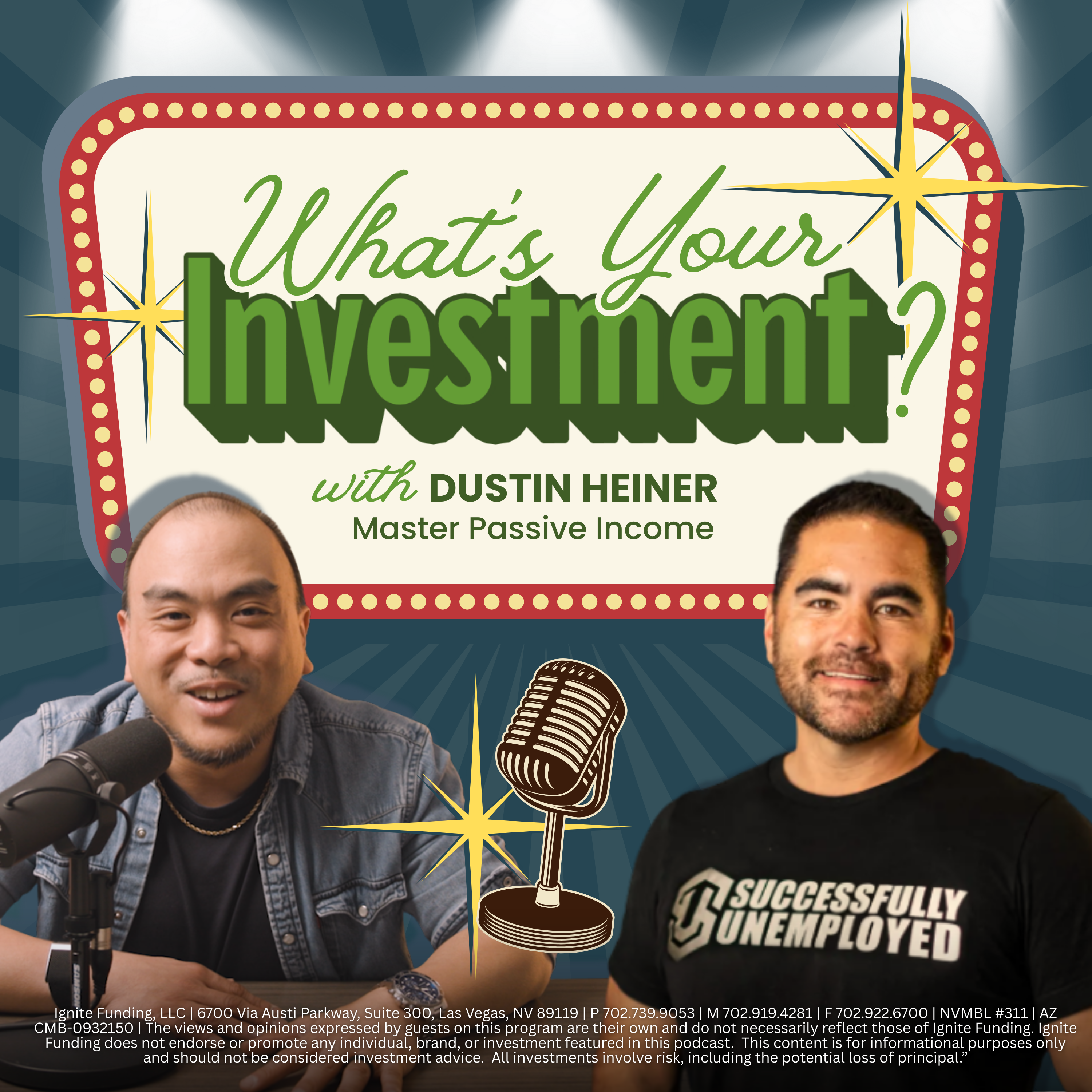
[00:00:16] Speaker B: Hey, how's it going? Ronald Arceo here. And we have someone pretty darn special, Dustin Heiner here from Master Passive Income. You've probably seen him, you've probably seen him on the YouTubes, you've probably seen him at the events Real Estate Wealth Builders Conference.
Let's move into what he's about though. He's been in the real estate industry for over, I don't know, 15 or so years. He looks like he's barely breaking a sweat there. In the last 37 years of his life, he was in his job and he quit. And from that point on, he's been able to achieve financial freedom or helping others at least achieve that kind of space and do it through real estate investing.
So around coaching, doing his podcast, doing everything on YouTube, being able to create the content, being able to help thousands of people understand this realm of investing, there's a lot of experience there that we could probably, you know, squeeze out a little bit.
He's been able to do this for a long time and not a lot of people can sustain this for such a long time, especially during different and difficult and various, different, various markets that are happening. So let's welcome Dustin Heiner on board.
Give them a rundown of who you are and where you're from. And for the people that don't know.
[00:01:34] Speaker C: You, what's up, Ron? Hey, thank you so much for having me on the show. That's exciting you guys are getting this podcast. I personally love podcasting, especially talking to real estate investors, other investors about investing. And so I personally, I invest in real estate. 30 plus single family homes, rental properties, majority of them are paid off. So I just get lots of cash flow.
Almost a thousand apartment complex units, invest in hotels as well, and then also coach, I don't know, thousands of students now how to invest in real estate. Because when I was quitting my job when I was 37 years old, I had so many people asking me how to, or basically how I was not working a job and still being able to provide for my family. And then I told them I invest in real estate. And this second question always came without, without a doubt it's going to happen. They say, well, can you show me how to do it? And so I said, sure, I'll start helping friends and family members and I realized that I enjoyed it and I had extra time, a lot of free time. I mean, imagine quitting your job and having 40 plus hours of your life back instead of working for somebody else. And so I just realized I really enjoyed it. So fast forward wrote a few books, best selling books. My podcast, Master Passive income. We're over 2.2 million downloads now. And it's really just a solo show. Me just teaching people how I invest in real estate and helping people.
And then now, like I said, coaching thousands of people. YouTube channel, even the conference like you talked about, the real A Wealth Builders Conference, bringing hundreds of investors together, really just helping people. In fact, my goal now is to help 1 million people to invest in real estate. And this is just a way for me to do it. I see. I make my money through real estate. I have so many properties. It's just amazing. All that cash flow is coming in now. I get plenty of free time and I just get such a high when my students buy their first property, 10th property, or become financially independent. It's just so amazing to be able to be a part of that entire journey for people.
[00:03:28] Speaker B: Yeah, you know, it's, it's great because there's a lot of coaches out there. You know, I've been in this space, in the coaching space. Not me personally, but I've followed this space for a very long time, for about 20 years or so, and seeing the best of the best. Stick to it. They got the stick to it. Iveness and they've been in it and they've, they've ruffled the feathers, they've gone through the rough dirt and they, they came out on the other end kind of a beacon of light at some point. And I'm assuming that's kind of where you're at at this stage of your life.
So let's talk about the beginning though. Let's, let's come back to the beginning. Before all of this stuff started, most people that are probably watching this may have seen the commercial locally here in Vegas.
It's, it, it talks about moving into passive income. We have. And maybe we'll show it here on, on, on the, on this episode. It's, it's interesting because it takes a, I guess you could say almost 40, 50 year old, still doing, you know, plumbing for his tenants. Right. And still answering the 2am phone calls. Still, still talking to his wife about why he's still doing this. And we wrote that script and you know, produced it and all that and it was fun to get it done. Because it really highlighted this idea of hey, there's a time when you probably got to move in another direction.
And so Talking about that 37 year old at that time being, being already versed in investing, let's go back maybe 10 years from that and then say 27 years old. What were you doing then? And yeah, what were you doing then? Were you in school?
Where were you at?
[00:05:07] Speaker C: Yeah, so I actually have a fun story of what really catapulted me to become a real estate investor so I can share that. So just like everybody, we're all taught from when we're born and grow up, you go to school, you get good grades and you take those good grades, you go to college, university, and getting tens of 20, 30 thousands of dollars into debt and you get a piece of paper called a degree and then you go and you shop around, you try to get a quote unquote career at a company and then you work 40 plus years of your life and then you retire 65, 70 years old and try to live on 40% of what you managed to save that entire time. Working at J O B is what I call it. It's a J O B, a just over broke job, because when you're working for somebody else, you're living just over broke. So I'm doing the exact same thing, the exact same path. In fact, I get the most stable, secure job you could ever think of. It's, I'm living in California at the time at a local county government doing it. So California's not going away, Government's definitely not going away and it's never going away. So I'm doing that. And at the same time, I bought one rental property back in 2006, bought one rental property and then I started making cash flow from that property. And then I realized, oh my goodness, I need to become an investor. Like this is what I need to do. But Ron, you know what happens? Life started getting in the way and so we started having kids. My wife and I started having kids. We had one, two, three and four kids. But this is really what shoved me to become a real estate investor and got me to where I am now. So when my wife had our fourth child, I went on paternity leave. That's where the dad stays home with the mom, changes poopy diapers and all that good stuff and bonds with the baby. Well, I go on paternity leave and in that same week I get back to work on a Friday at 3:30 in the afternoon, I get a call from my boss's boss's boss's secretary, like the top dog. And she says, dustin, would you please come to the office? I said, sure. And I hung up the phone. I paused for a second. I thought, why are they calling me the office? Like, this is not normal. And I've seen plenty of movies. Friday at 3:30 is not a good sign. So I started thinking about my life. And I started thinking about. Oh, my goodness, about a couple months before I went on paternity leave. There were some rumors that there was budget issues in the county. And I. There was potentially layoffs. I said, there's no way I've got so much seniority. My boss is thinking to do a grave job. So I shook it off. Well, I get up and I go to my boss's office and I start walking down this hallway. It's not really long. In fact, it's kind of short. But every single step that I took, it felt like the hallway got longer and longer and longer. And it felt like my feet became lead bricks because the way to potentially losing my job was starting to crush down on me. Well, I get down the hallway and I turn the corner and I see my boss's door. His door is closed. And I see his secretary there, super sweet, nice old lady. And she says, dustin, would you please have a seat? And she's kind of sheepishly grinning at me, trying to console me with her eyes because she knows everything about what's going on. I know nothing about what's going on. Well, I take my seat and I start thinking about my life. If I get laid off right now, did I just waste my life doing something that other people told me? And I thought, oh my goodness, if I don't have a job, I'm not going to be able to provide for my family. Does that make me a failure as a father, a failure as a husband, as a man trying to provide for his family? Well, as I'm sitting there, my hands get all clammy, my forehead gets all sweaty because the nerves are just crushing me. Then the door to my boss's office opens up and I'll walk to her coworker of mine with a piece of paper in her hands. She's noticeably distraught, very upset, not necessarily crying, but you could tell her world has just been rocked. She passes by me and then my boss says, dustin, will you please come to the office? So I get up and I go into his office and I get laid off. And this is the government, remember? Nobody gets fired or laid off from the government. But I did so, and this is the reason why I tell the story. I take that layoff notice and I go back to my desk and I sit down and I realize two things sitting there in my desk. Number one, I need to get another job. I need to be able to provide for my family. So I was blessed, praise the Lord, to find another job in the same county, a different department, wasn't having those issues. So check. Got that. But then the second thing, sitting there, just getting laid off, I realize I need to make sure this never ever happens to me again. I need to make sure that nobody can take away my ability to feed my family. So right then and there, I realized I will no longer let life get in the way. I'm now going to. Instead of telling people when they ask me, what do you do? We always answer the question, everybody does, oh, I work for, you know, your job. This is your job. And I realized I'm projecting out to the world that my value that I put on myself comes from my job. I realized my value does not come from my job, it comes from my God and from myself and my family. So right then and there, I started telling every single person I am an investor. Even though 100% of my money came from my job, that's now my part time job, I'm a full time investor. So quickly, fast forward the story started buying property after property after property, each one making me 4, 5, $600 or more in passive income. Eventually I have 30 plus properties like I'm, why am I working here? So last quick part of the story went to my new boss, good boss and all. When I had plenty of properties, I said, I'm laying you off like, here's your layoff notice. And we both laughed. He says, dustin, what are you going to do? I said, I don't have to do anything. I have real estate that works for me. And so the last part of the story, I would walk to and from my car to my job every single day. A mile and a half each way because I was too frugal to pay for parking. Done a thousand times. Last time I walked to my car, I felt like I was walking on clouds because I knew I would never ever need a job again. And for you listening, I want you to realize this. You are worth so much more than anybody could ever pay you. And this is how you'll know your boss is paying you just enough to keep it working without quitting, but not so much money. It takes money out of your pocket. If they paid you what you were worth, they would go broke. So instead what I suggest is to put your value that you have in yourself and do something like investing in real estate, buying properties that create cash flow, passive income every single month. And then you now can have 40 plus hours of your life back then working for somebody else. So I'll pause the story because you probably got plenty of questions.
[00:11:08] Speaker B: Yeah, it's great. It's an awesome process to see how many people have this, this investor's mindset, right. Where you're moving from a job to a even more cushier job, let's even say, and then to this space of an investor. And you know, I, I freelance a lot, I helped a lot of businesses, very much entrepreneurial kind of mindset.
But that's different than an investor's mindset, right?
Very, very different.
And being in this space for a good chunk of time, just working as a, as a web designer, you know, tech stuff.
[00:11:53] Speaker A: Right.
[00:11:53] Speaker B: You were in tech space. So web designer, video video person, all this stuff, Digital marketing, Right. And being in that space for 20 years, there was no, no business for me at that time, during that time frame that I could actually sink my feet into and just say, I'm going to build your stuff out.
Nobody was budgeting for a videographer or a web designer. It was almost like, I'll just contract you real quick and you're out. So my entire process of building business was I'll get a client for a couple months, I'm at capacity, toss them out to the next one, hopefully they're good, get another one coming in. The focus of that was very similar to let's say, 40 different properties, right?
Very similar. I mean, I don't have 40 different clients, but if it was 40 different clients, 40 different properties, I could imagine how difficult that was from your very start to that point of, let's say, the second portion of the other job. Right. So tell us a little bit about that, that journey between part one to part two of the act.
You started with one, you got to 30 to 40 within. I didn't catch the amount of time frame, but I'm assuming it's not that long because of an investor mindset. But you're still at the job, right? So give us that, give us the understanding of that juxtaposition.
[00:13:16] Speaker C: Yeah. So what I'll also give you too is a different mindset. The investor mindset is one that we start with, but then we have to transition to something which I'll share in just a second. So when I bought my first property in 2006, I was doing what all those quote unquote gurus. Now, there weren't TikTok gurus or Instagram gurus, there were infomercial gurus. So I was following them, spent lots of money, wasted money on their, you know, thousands of dollars and stuff like that. And when I bought my first property, my property manager started stealing from me within six months because I did not know what I was doing. I was not taught how to do it right. But then I had to re. I realized very quickly and I didn't get give up because if I gave up, I would not be here today. I wouldn't be coaching thousands of people financially independent. Well, I realized that if you approach it as an investor mindset, which is not a bad mindset, but we have to grow into a business mindset, a business owner. And this. Let me explain what that looks like. So when you're investing in real estate, you buy a property and you do not want to be like a stock market. You know, you put money in the stock market, you set it and forget it, and hopefully the stock goes up. We don't do that in real estate. This is what we do. And on my podcast and what I coach my students is we need to become a business owner. And this business owner mentality mindset, obviously you're an investor too, but if you approach it as a business, then you can scale because you have other people, experts doing the work for you, from funding to finding properties, to managing properties. And so what I realized was I was hitting a ceiling. I could only manage so many properties, and then eventually I could. I was pulling my hair out because I had too many problems that I had to deal with. And I thought, what? I want to hire people, do the work. So this is what it looks like. So when you're building a business, give you example, let's say you want to start a convenience store, you know, candy bars and soda machines, all that good stuff. You would not sign a lease on a location, open the doors and set a box of candy bars in there on the ground. Now, you wouldn't do that. You go out of business in two seconds. But what you would do is you would build the business. First you get the gondolas, those shelving units, all the candy bars go on, the countertops, cold storage, bank accounts, cash registers, insurance, employees, everything in the business before you buy any inventory. Then once you have the business built, then you buy the inventory and you put it into your business. Same thing with real estate investing. We build the entire business. We get all the experts that are going to be doing the work for us and then they help us to make sure we buy the proper, the right inventory. That's what I do now is I make sure in every city I invest in Ohio, Texas, Arizona, Tennessee and Indiana and everywhere that I go, I make sure that I build a business that has experts finding the properties for me, managing the properties, fixing up the properties. Because I, you know, after coaching thousands of students, now what I've seen is a lot of people, occasionally it'll come to me and they say, hey, Dustin, I follow those TikTok gurus. And I went and bought a property, spent thousands of dollars to buy it, spent thousands dollars to fix it up and then try to find a tenant. And I couldn't. And I tried to find a property manager, couldn't because every property manager I called, they told me they would not manage it because they'll get shot there. I'm like, you don't have an asset anymore. You have a liability. So instead of calling up property managers after you buy the property, my suggestion, you build the business first. And then instead of saying, property manager, already bought this property, will imagine they say no.
Instead, what you do is you say, property manager, I'm looking to buy this property. Will you manage it? How much will rent for? What's the vacancy factor? What's my clientele like? And all these great questions about the property. If they tell you, no, don't buy it. Like, I'm not going to manage it, then you don't waste the time and money buying this property.
Instead you then have them tell you everything about the property, how much will it rent for, and all that sort of stuff. And then if they say yes, that's when you buy the property. So that's how we scale to where you do get to 10, 20, 30 plus properties. In fact, what I love about real estate investing, it's very simple math. And I'll one last thing, because I want you to jump in because I know you got questions, but it's very simple math. If I realized If I bought one property that made me $500 a month in cash flow, passive income every single month, well, that's $6,000 a year. He said, ben, that's great. What if I got 10 properties at $500 a month, that's $5,000 a month, that's $60,000 a year without working.
20 properties is $120,000 a year, that's $10,000 a month. It's like, man, I could quit my job if I got that many properties, so I just kept buying more and more properties. And when you focus on remember $500, that's the minimum I may, I have properties make me $3,000 a month or more and I have 30 plus properties. So that's what I suggest is if you're going to do it right, this is what I figured out. The system is basically building a business, getting the right people before you buy the inventory and then they are the experts running the business and making sure you don't buy a money pit.
I love that.
[00:18:17] Speaker B: It's.
Man, there's a lot of gems there.
The system, running it as a business, finding the inventory and finding the people prior to all of that is interesting in its own right. And it's a solid plan I would say because I've seen it work in many various formats in real estate.
So let's talk about that. I love the idea of building the system first, finding what almost the expenses are, right. Finding what your, I guess your nut would be or your, your minimum viability to create the, the, the system in the business and finding the right people to let's just say audit, analyze, give you feedback, find different areas of expertise to help you make that decision. Almost like your board of directors, I guess you could say.
And then from there it's the inventory, the and then throughput of that inventory. Meaning to say, you know, what's the money in money out when it comes to inventory in scale. Because how long did that take you? Actually maybe that's how long. So one to the, to the 40, 30, 40.
[00:19:25] Speaker C: Once I realized that I had a system, that's when I started branching out to other cities.
So it probably took me about seven years from, from when I really started going after it to become financially independent because that's when I started buying real estate. But I was figuring out on my. Now honestly, my students are doing it three to four, maybe even five years at most because I've shortcutted the way because I've did all the wrong things. I've figured out all the wrong people to work with. You don't work with them. You work with the right people and how to streamline it and fast track it.
[00:19:56] Speaker B: For people that are starting out investing and they have no idea what it means to be passive.
You have all the experience. I'm just talking about passivity now, not talking about investing in a particular project or anything like that. But like what does that actually mean for you?
[00:20:14] Speaker C: For me with when I look at having a passive income business, I like working one time and getting paid over and over again. If you, I guess flip that, it's the active business or active job, that's what you're, you're working one time, getting paid one time. And I realized that back in 2000, 22,006 when I first started investing, I needed to stop doing the active income where you work in one time, get paid one time. And then when I realized there's such a thing as cash flow or passive income where you work one time, get paid over and over again. Then I said, the only thing I want to do now is I will only go after passive income businesses. I have multiple businesses now. And so what I realized was that if I figure out ways to make sure that it's automated or other people doing it, I'll give you a quick example. Like my real estate investing, my properties, they work for me. They're the ones doing all the heavy lifting. Or it, it is the one doing all the heavy lifting. But then people say, well, don't you got to manage it? Like, no, I don't got to manage it. I hire the people to manage it. And then the second question is, well, Dustin, how do you afford a property manager? I'm like, I don't afford a property manager. In fact, I don't pay for my property manager. I don't pay my mortgage, I don't pay my taxes, I don't have to pay for repairs, vacancy. In fact, like, I don't have to pay all that stuff, meaning I don't have to job to pay for that. My tenants pay for all that. All I do is I account for every single expense that this property will have. And then I make sure that my cash flow, it's itemized out as another expense line item. So if I know, and this is what I suggest, all my students try to get $500 or more. That's the minimum. When you buy a property for $500, that's your expense, your profit is an expense. And so I add all the expenses up, like the mortgage, insurance, vacancy factor, repairs, property management, and your, your profit that you want in there, add it all up and if your rents equal that or more, then you're going to be making money. Because I did not want to guess and hope to make money. I wanted to make money in cash flow. In fact, I don't even invest for appreciation. I will hold on these properties forever and I'll give these to my kids in generation wealth. We have five kids now and I'll give these to my kids. But at the Same time, what I realized was it's the cash flow. The appreciation will come. In fact, there's proven stats or stat like you just look at the growth over history.
Real estate doubles every 15 years. It's just proven fact. Now go to the fluctuations up and down, but on average, it doubles every 15 years. So if you buy one house, that's $150,000, which, yes, there are properties that are still $150,000. In 15 years, that's gonna be worth $300,000. And then 15 years after, that's gonna be worth $600,000. That's the. Just the value of it itself. And your tenants are paying off the mortgage and the interest on top of that. Plus you're making cash flow. Plus, if you do it right, you're gonna capture equity, which means you buy it for less than it's worth. And then you capture that equity. And then you also get forced appreciation where you put money into it and, and you make it worth more than you put into it. And then you also get tax advantages. Your tenants pay off. There's so many amazing things about real estate investing. But in the end, what I realized was that it was the passive income and then automating other things like my other businesses. I have as best I can. I automate everything. Like my podcast. Anytime I put out a master passive income podcast episode. Like I said, it's just a solo show. Me just giving out all this free information or a YouTube video that's. I did that work one time and it's out there one time and it gets listened to over and over and over again. And then I also have emails that go out to people like all my students. I send them emails automatically because I already have. I know the steps that they need to go through. So I said, okay, here's your next step. Here's next thing. So that's what I love to do, is I look at, see, in what way can I remove myself?
And here's a great question. A good, good buddy of mine, he asked this question and he's a type of guy, actually, what his business is. He takes companies from six figures to eight figures. Like, he helps people to grow. And his number one question is, what needs to be true in order for X, Y, Z to happen? Like, what need, like if I need to remove myself, what needs to be true? And it could be one thing is like, okay, I need my property to run without me. Well, what needs to be true? Well, I need to pull myself out of the management of the property or what needs to be true? I don't have any money. I need to talk to ignite funding or I need to get other people to do, you know, be a part of it. And so that's the question I always ask myself when I'm looking at active income versus passive. What needs to be true to remove myself to get other people to do that work or systems, procedures and processes?
[00:25:08] Speaker B: So let's talk about time, talent and treasure. You mentioned a bunch of things here that were interesting and I think that we could touch upon.
I'll relay that comment that you had made because I wrote it down as we talk about time, talent, treasure. So doing this for this long now, being able to reach financial independence, being able to coach and train and help others, being in love with this business building, real estate investing thing, not a lot of people can hold onto those passions for very long lest they fizzle out five years, one year later. Right?
How have you been able to keep the drive to go and keep that time? How did you invest your time during this process?
[00:25:56] Speaker C: Yeah, and I love what you're talking about and what you're thinking about. Time, talent, treasure. And let me add something to this.
Now there are four legacies or four things that we need to every person needs to develop in their life. And so the first one is the hardest. But then once you get this, it leads into the second, third and fourth. And I'm already on the fourth, which I'm very, very blessed to have. So the first one is a money legacy. We need to have enough money that comes into our lives to be able to afford whatever we want. And that afford meaning not work, a job too, but also being able to have enough money to pay for your expenses. So that's number one, we need to have a money legacy. But then that money legacy leads into a time legacy where we now have more time in our lives. Imagine 40 plus hours, your life back rather than working for somebody else. You get 40 plus hours of your life back. Then that time legacy. You know, when you're building your, you know, getting money first and then now you get more time when you're getting to that money legacy, you might have some problems along the way with relationships. Well, your money leads into time, then time leads into relationships, then you build up your relationships that might have faltered, might have had issues on the way up because you didn't have any time. But now money leads into time, time leads into relationships, and you make your relationships really solid. Everybody, friends, family members, all that sort of stuff. Then this leads into the Last legacy. And the last legacy is where everybody needs to get to, and it's going to be so hard. So trust me, if you're listening to this, more than likely you're gonna think, okay, Dustin, I get this fourth one. It doesn't really make sense, or it does, but you will not understand until you're actually living in it that this is all you should be thinking about.
Money leads into time.
Time leads into relationships. Relationships lead into the last legacy, which is service.
When you're serving other people. Trust me, I've been living in this for almost 10 years now, where I'm only focused on serving more and more people. And that's my goal, is to help 1 million people to invest in real estate. And what's so great about living in the service legacy? Number one, I am so much more fulfilled in life. When I bought my first property, it wasn't. I didn't feel fulfilled. I felt like it was an accomplishment, which was great, but I needed another accomplishment. When I quit my job, it was a great accomplishment, but I felt like I needed more accomplishments. When I actually helped my first student to buy their first property, it wasn't my accomplishment, it was theirs. I felt fulfilled because I helped another human being get what they most wanted in life. And then when they start to get to the point of financial independence, it's like, oh, my goodness, I feel so fulfilled. So that's number one, fulfillment. When you're living in the service legacy, you feel fulfilled. Here's the amazing side effect of this that I didn't realize until I started living in this. Now this is all I want to do. I help other people to make so much money that they look at me and say, dustin, how do I give you more money so you can help me make more money? Meaning the more money I help other people more when I serve other people, the more money they make, but then also the more money that I make as well. And so the more people I serve, the more their life gets better, the more my life gets better, and the more everybody wins. And so if we focus on a win, win, win, then that is going to make everything so much better. So that's what I think. Time, talent, treasure, you should go. Money leads into time. Time leads into relationships. Relationships leads into service.
[00:29:28] Speaker B: You talked about time. You spent a lot of time investing in your skills, investing in investing, investing and teaching people the talent. So we went. Time.
Talent would be, I'm assuming, would be the ability to create the community around this. You tell me, is that. Is that what is that the case.
[00:29:45] Speaker C: I would say I'm really good at moving forward in a direction that I want to go and then inspiring other people to do it as well.
And so what I think is I found inspiring other people that I try to emulate is just being so passionate about it, about something. And as you're moving forward, people are going to rally around you because they see you doing it. And so I'm so, I guess almost even one track minded, where my sole focus now is to serve as many people as possible. In fact, my goal is to help 1 million people to invest in real estate. And so because that's a goal that I am shooting for, striving for, I'll probably never reach it, but at least it gets me out of bed and it gets me excited about helping more and giving more people that every single day I wake up and I'm like, how do I inspire more people to change their life to, you know, get out of the mundane? Because honestly, I think everybody's worth so much more than anybody could ever pay them. So if I can help people, that's my talent is I'm able to inspire people as best as I can. It's like, hey, I, I'm going to keep moving forward and I'm going to help you along the way. Like, think of me as your next door neighbor that just figure out something and I'm here to help you. And that's why, I mean, my podcast, the Master Passive Income podcast, is over 2.2 million downloads now, is because it's just me giving, just teaching and teaching and teaching. And it's all like, man, in the end, the only thing I want to do is help other people change their life. And I feel fulfilled in the end when I do that.
[00:31:17] Speaker B: With all this being said. Time, talent, treasure. We didn't talk about this, but let's, let's end it on this.
What kind of investments do you do with your treasure? And it doesn't have to be money. It could be anything that you like.
[00:31:31] Speaker C: So that's a.
I'm gonna. So I'll share it by saying this.
My treasure is in a different perspective than most people would think. So I read the Bible multiple times a day. Not just one time a day or even once a week, but like multiple times a day. In fact, my, my kids, ever since my oldest daughter, she's 17 now, but since she was 3 years old, we were reading. We. I've read the Bible to them every single night since she was 3 years old. Like, literally without fail, we may be fit and missed maybe five, six times in her their entire lives. So when I read the Bible, I take that so seriously that I start realizing that treasure is not stored up here on Earth.
On Earth. Of course we're going to have great things that money can help us to buy things, which is totally, totally great. But when I read the Bible, it says, store up for yourselves treasures in heaven, where moth and rust do not destroy, where thieves cannot break in and steal. And you want to store up your treasures in heaven. So what I do now is I also spend my time as much as I can with sharing people about finances and real estate investing. But at the same time, I always talk as best I can about the Bible, about what it's done for my life and how God's changed my life for the better. Because, honestly, in the end, everybody's going to pass away. It's sad, but everybody. It's 100% proven fact. 100% of people die. And so what I started realizing was there's got to be something else outside of this. So my treasure now is everything that I look at is everything that I own, from the real estate to my, you know, money and all that sort of stuff. It's all God's, and I'm just a steward of his stuff. And so if I use it to glorify him by, you know, let's say, giving to other people or helping other people or whatever it might be, which is we would love to do, then that is glorify him, which is also storing up treasures in heaven. So that's my perspective on the treasure portion.
[00:33:30] Speaker B: Love it. And, you know, there's so many different aspects of the way you can invest your treasure.
And this is one of the ways that I truly believe service to those that cannot help you is one of the greatest treasures to invest in. This podcast hasn't been about the investments. It's never been about, you know, the techniques or the strategies or whatever. Those are different podcasts that we have. This podcast is really about the heart of people, and the heart of the people that have. Are on the way to making it, are making it or have made it and what they're doing to give back to the community. And I appreciate you, Dustin, for being here. You know, Master Passive Income is much more than a. Than a thing. I believe it's a community. I believe it's a movement. We here at doing this podcast believe passive passivity is our. Is the biggest way to help people grow without being tied down with their time.
And that passivity can be compounded, you know, by experiences with people in relationships. And I really hope that this podcast shows others that relationships is. Is one of the key things that matters in this life. And if we can protect those and. And honor those and. And have better relationships with the people around us, the better our life will be, the better we'll enjoy it. And no matter what comes, at least. At least we have good people around us. And that's what this podcast really is about. So thank you so much, Dustin, for being a part of this.
I leave with one question. I know my. My team's getting mad at me right now. I leave with one question. If you could go back to the beginning, from the very start, you know, looking back on your future and tell yourself what you would have told yourself back then, what would you say? What's the one thing you would. You would tell yourself?
[00:35:14] Speaker C: It's. It would definitely. Obviously, passive income is one. We talked about that. But what I would say is, and it really comes down to, is being determined to make something, to master something. And so I look back over my life and everything that I've done, I've put so much focus into it until I mastered it. And when I say master, it's not like I'm the best ever at it. It's when it works well for me, where I put less effort in because I'm efficient at it. I figured it out, and it's moving the needle like it's making me money. It could be writing books or the podcasting or social media. Like, I'm over 250,000 followers on Instagram now. Just organically working hard, mission critical.
[00:35:53] Speaker B: I mean, to get people to build generational wealth has been my go to here once I started here, and it's been the focus. And I didn't know how we were going to do it. Like, you know, you kind of set the goal, you go after it, you course correct along the way. And, you know, it's funny, you have a goal of reaching a million investors or getting them started. We have a goal of growing our investor base, our active investor base.
We're in the lower thousands. We're trying to get into the double digits of the thousands over the next few years. And to do that, it's kismet, right? When people come into play and it's. It's almost like, oh, wow, this is. This is. This is supposed to happen.
And I think this episode's supposed to happen for everyone listening, you know, to learn about passive income. I mean, for Dustin to give that portion of his his life away for potentially on this, and to be able to tie this back around to what we also do as far as helping investors is key. And I think at this point we could actually even ask Dustin here in the future we'll probably do something together.
I'm assuming we're probably going to be doing something together and if that's something that you guys want us to to put together as terms of like an educational piece together, something like that, where it's more of us and we're really given an educational piece around this idea of passive income and investing in real estate particularly. We do it a little bit differently, obviously on this side that I won't get into. But it's, it's a great, I would say a great way to understand as a whole what's going on and maybe we can kind of create something around that for the community that you have in the community that we have together. So this is all about service. This is all about us, given what we got the best we can. And I think we have a great kindred spirit here to move this, to move the needle forward and to kind of move this into the next generation's wealth to come. So thank you again, Justin. Thank you again, Dustin. I appreciate it. It's been a pleasure being here with you.
Everybody go check out Master Passive Income, check out the descriptions down below and I'll see you guys again soon. Take care.
[00:37:53] Speaker C: Thanks, Ron.
[00:37:55] Speaker B: Hey, thanks for watching the what's your Investment podcast. Please like, follow and comment. And don't forget, check out our other videos. We got the Deeds in the Desert and the Day in the Life episodes. See you there.
[00:38:06] Speaker A: Thank you for tuning in to this episode of what's yous Investment? Brought to you by Ignite Funding. Don't forget to like, comment and follow for more. Check out our other podcast feeds in the Desert and let us know who you would like to come onto the show. We'll see you next week.
The views and opinions expressed by guests on this program are their own and do not necessarily reflect those of Ignite Funding. Ignite Funding does not endorse or promote any individual brand or investment featured in this podcast. This content is for informational purposes only and should not be considered investment advice. All investments involve risk, including the potential loss of principal.