Episode Transcript
[00:00:00] Speaker A: Welcome to the what's yous Investment Podcast presented by Ignite Funding with Ron Arceo with featured guests. Weekly podcasts that explore your time, talent and treasure, like share and follow. For more what's your investment? Let's get to the show.
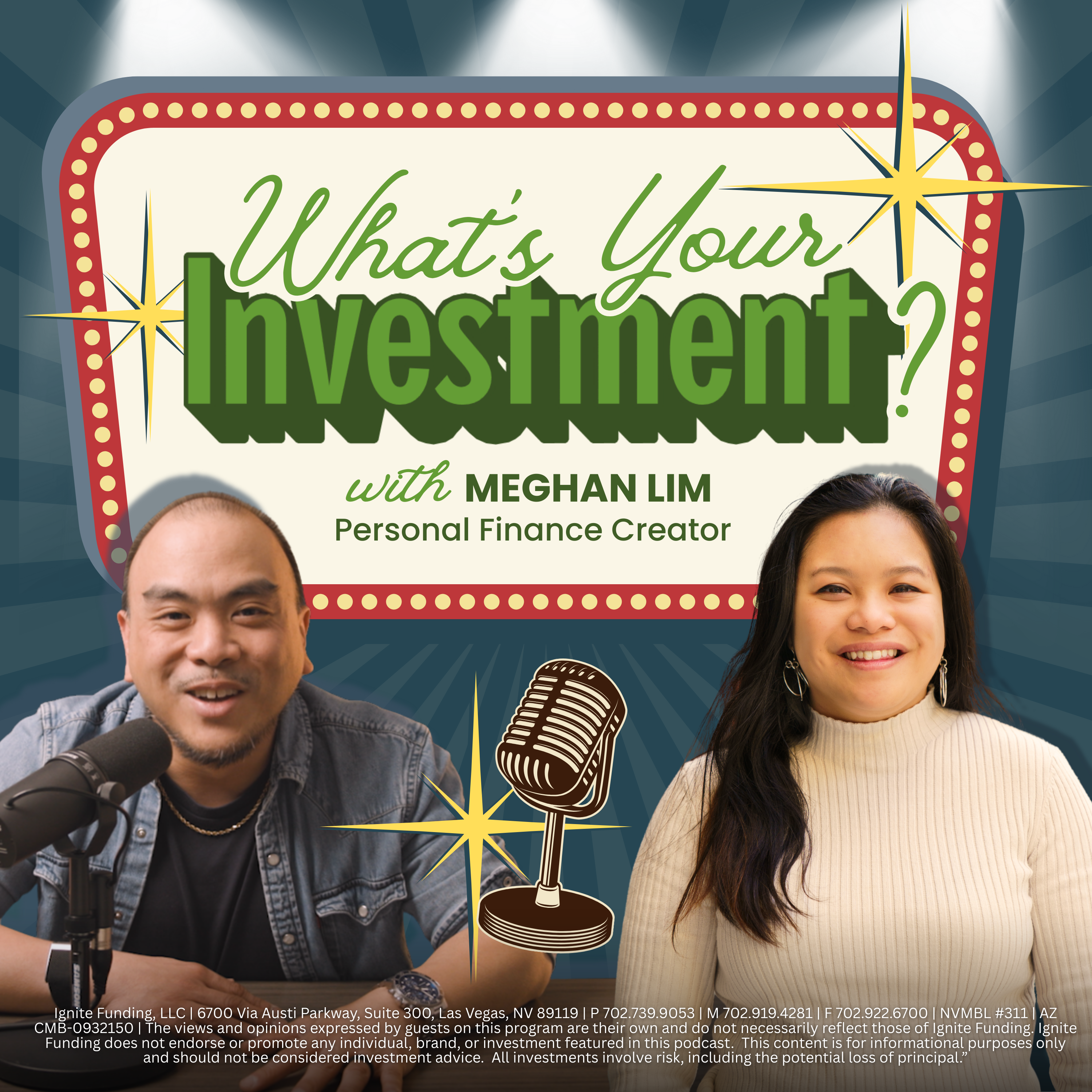
[00:00:15] Speaker B: Hey, how's it going? Ronald Arceo here with the what's yous Investment Podcast. This series talks about your time, your talent and your treasure, but not about us. It's all about our guests today. Today we have Megan limited. She's from Megan Makes Money. If you go look her up, you'll know that she has over about 160,000 followers online. She's been her claim, I don't even call it a claim to fame. Her, her rise to the, to the finance space is backed by really the sales that she's been making on her financial templates from her start. We'll talk about that a little bit later on.
Let's bring her here because she's moved from this helping in corporate finance, Fortune 500, and now she's helping others across social be able to make money, or at least in different ways, I guess you could say. So let's bring her on. Megan, how are you? Welcome to the show. Tell the people who you are and what you do.
[00:01:13] Speaker C: Hi, Ron. Thank you for having me. My name is Megan. I'm a content creator. I've been doing this full time for almost two years.
And essentially I teach all aspects about money on my page, from budgeting to finance tips to business tips. And my goal really is to show people how money can be used as a tool to live your best life. I went from working in corporate finance to being let go multiple times to now working for myself by diversifying my income streams through online. And basically, I like to use my platform to show people that it's possible and that you can live a life of freedom by putting yourself out there and monetizing your passion.
[00:01:58] Speaker B: Yeah, when people talk about monetizing their passion, some people may be like, I don't know what my passion is, or I don't know what to do in this. I'm too young or I'm too old maybe, or I don't even know. I've been stuck in this corporate job. I don't even know what to do. Let's talk a little bit about why you went from shifting corporate finance to this Fortune 500 from Fortune 500 to where you're at now. What was the catalyst or what was the beginning phases of it?
[00:02:33] Speaker C: Yeah, so before I got that finance job, I was actually A junior financial analyst at another company. And, and what had happened was I was unfortunately let go. And so during this time, I was unemployed for quite some time and I was just applying to new jobs, while at the same time I also had a lot of free time to start creating content and start a new business.
I saw that people were making a lot of money through social media. They were making money from brand collabs, selling digital products, or affiliate marketing. And I thought to myself, if they can do it, why can't I?
So for those nine months while I was applying to jobs, I was also posting content. And I told myself that I would do this for an entire year, just post daily and see what happens, because the worst case scenario is it doesn't work out and I just like go back to a job. And so I was still doing that alongside my search. And so while I was doing that, I wasn't really making any money from my content because I was still building that personal brand and posting every day. And, and so it took a while to build that trust and following with my audience. But then eventually, around October 2023, I attended this conference called Fincon, which is basically a personal finance conference for creators. And so I met some of the top creators there who were also posting content. And they had been doing this full time. And so just seeing them and talking to them kind of gave me that reassurance that it's possible. And so I listened to them. They gave me their best tips, tips and advice with like making content and, you know, filming myself better, scripting my content. And so all that information I took in, I implemented it into my own content. And so two months later, I had one video that went viral and it completely changed my life because I was also selling a budget template and so I was making thousands of dollars in sales.
And around that time I had also just started my finance job and it started to not be as good as I thought it would. I didn't really enjoy the team I was working with. I was very lost and confused and every day I just dreaded going to work. So after three months of doing that job, I was still earning more money from content creation. And so I decided to take that leap of faith and just quit my finance job and go all in on content.
[00:04:52] Speaker B: Wow. You know, a lot of times when people go all in on something, it's, it's hard, there's a decision making process and it's, it's tough. So you were kind of in a, in a situation where you were in unemployment, you were Creating content during this time you weren't making. It wasn't monetized yet.
[00:05:16] Speaker C: Yes.
[00:05:17] Speaker B: And you got. You barely got into this, or you're almost getting to this new job and then a piece of content goes viral.
[00:05:26] Speaker C: Yes.
[00:05:26] Speaker B: At some point. And before this, you were at a conference right before. Before the. Okay. And from that 2023, you said.
[00:05:36] Speaker C: Yes, this was the 20th of October 2023.
[00:05:39] Speaker B: October 2023 was when you went to the conference. Okay, Went to the conference. And then after that you had a piece of content that went.
[00:05:49] Speaker C: Yeah. Viral, like a month later.
[00:05:51] Speaker B: A month later. And from there you capitalized on it and said, oh, or did you get the job yet?
[00:05:59] Speaker C: I. I got the job. So as soon as the conference finished, I started my first day on the new job.
[00:06:05] Speaker B: Oh, wow. Okay. So you were already. You got the job, you're doing the content still, and then all of a sudden this piece hit and now you're able to. To create more income for yourself versus your job.
[00:06:20] Speaker C: Yes.
[00:06:21] Speaker B: Cool. And then that's kind of where you're at now at this stage. Full time?
[00:06:25] Speaker C: Yeah, I've been doing this full time. It's almost two years, so it'll be two years in January.
Wow.
[00:06:30] Speaker B: How does it feel knowing that you've gotten this far along within this short amount of time being able to replace your income, so to speak?
[00:06:38] Speaker C: Yeah, it feels good. I mean, of course, like, part of me still feels like there's uncertainty. That's something I learned to recognize with business, is like your income kind of fluctuates. However, for me, knowing that I am going to be okay is just knowing that I'm surpassing my corporate salary. So I've like, the first year that I went all in on content, I earned six figures, and that was my first time in my life ever earning six figures. And this year I also make six. I made six figures too. So as long as I'm making more than my corporate job, then it's telling me that this is the right path. But yeah, it's been a great ride so far. I don't work as many hours as I used to. I'm a lot more fulfilled. I'm also in a big city. Like, I live close to New York City, so I'm always constantly connecting with other creators, learning about new ideas, and always just trying to expand my learning through this process. Because with content, things can change, algorithms can change. So it's really important to kind of modify your business and also diversify your income streams. That way you're not just stuck relying on one income source, what was the.
[00:07:46] Speaker B: Deciding factor that made you go full time? Was it just them? Was it just the financial or was it more on the finance? Like more. When I say financial, was it the income, I mean, or was it more of the. A mission of some sort?
[00:08:01] Speaker C: Yeah, so it was, it was always my mission to do this full time. Like even while I was unemployed, like it was my mission to be self employed and earn from myself. And I think like what kind of made me really go for that mission was after I lost my first finance job, I took the time to travel. And so during that one long month, like or since I was given a three month severance, I decided to take one month off and just like travel. And so I saw my family in the Philippines, I went to Japan and Korea and I think like what really motivated me was kind of just like seeing my Lola as my grandmothers and I, like, I don't really have a big relationship with them so I've only seen them less than 10 times in my life. And so I was really moved by wanting to be able to see them and like see my family in the Philippines. And so I knew that if I wanted to do that I had to be self employed because if I was with an employer then I wouldn't be able to get as much time off and go see them. So that was a very big motivating factor for me. And also just like the freedom to travel and just freedom to wake up when I want and make my own schedule.
And so once I was able to surpass my corporate salary with content, I also knew that I could keep this up and just I trusted myself and so I made that switch and then I was able to kind of live the life I always wanted. Like I was able to travel more and more. My first year of doing content full time, I actually was a digital nomad for four months. So I went to like over 10 countries and it was a very eye opening experience. And I kept my cost of living low too because when I was in Asia things are a lot cheaper so I was able to sustain myself as well.
[00:09:55] Speaker B: It's cool that you're able to kind of see how the cycle of time and money kind of just cycles. There's a lot of people out there that are, you know, business owners, entrepreneurs, students, even where their achievement is tied to, let's just say, money. I'll just use money because it's an easy example, but it could be anything.
They're tied to their money and then they're tied to it. Because their times in that space. And then there's other folks that. Where they have a lot of time but no money.
That's. That's another space, right?
The cool thing about whether you're corporate salary, whether you're creating content for people to consume and you're earning an income doing that, the beauty about it is the time that you're spending.
If corporate Sally, is your thing, that's great. Awesome. Go there. If creating, being creative is your thing, go there. Whatever the case is, it looks to seem as though time and money obviously have, least in this society, a cyclical factor to each other. And to balance the two is where most people have a. A tendency to.
To be challenged in.
What have you learned in the last two years that allowed you to know that you wanted to be an entrepreneur?
[00:11:14] Speaker C: That's a great question. I think, like, it has always been ingrained with me since I was a kid.
When I was younger, I used to, like, when I was in middle school, for example, I used to sell celebrity posters to my classmates. So I would have like a photo printer at home. And so I would take photos of their favorite celebrities and print them and then charge like $5.
So that was just like a little fun thing I did. And then I remember in high school there would be. There would be people selling candy for a purpose, like whether it's like a church fundraiser or whatever. I had no purpose. I just like wanted to sell candy to make money. So I went to Costco with my parents and I asked if I could buy some candy. And I would sell it in school. And so I would sell it around the time that kids were selling candy. So I didn't look suspicious because if I was just doing that, I would probably get in trouble. And so I would just sell candy and then use that income for myself, like to buy what I wanted and.
[00:12:14] Speaker B: Hustler.
[00:12:15] Speaker C: Yeah, I was, I was always born a hustler. I think it really, really took off too in college where, you know, like, I think everyone goes through that period in college where you're broke and you don't have money, and you just really want money to be able to fund the lifestyle you want. So I started like, looking up things like how to make money online, how to like, side hustles to start. And so I started like, pet sitting. And I also tried dropshipping too, and that inevitably failed. It was a lot of hard work, but it also like, taught me a lot. And I think, like, that knowledge carried through from dropshipping to what I do now. In my business since I sell a digital product.
But I was also like doing food delivery. I was pet sitting. And so pet sitting was the one business I think that I really enjoyed and could keep doing.
And as, as someone who like, does service for other people, I always get it my all. And so when I was pet sitting, like, people genuinely loved how in touch I was with like, communication and how I was taking good care of their pets. So one of the big things I realized in business is like, if you do a good job, people will refer you and you'll just get more clients and then your business will do better. And so when I was pet sitting, like, I remember when I first started, I was charging like $20 a night. And the first client I ever got was super amazed and happy. And he, I think he gave me like $100 as a tip. And so that kind of motivated me to keep going and just like take on more clients. So when I was charging $60 a night, I kept getting booked over and over and it was coming to be a lot. And then that's when I realized, like, I needed to charge more.
I was actually watching another person on TikTok who was pet sitting and he was charging like $100 a night. So then I thought to myself, oh, like, what would happen if I just like raise my rates to $100? And I did. And so I started getting like higher quality clients.
So my clients became like lawyers, doctors, business owners, and they were, you know, they had much nicer homes and they liked me a lot. So they would refer me to their friends who are also rich. And so I was making like on average a thousand a month, just like pet sitting as a side hustle on top of my corporate job. And I think I realized like, oh, the big pivotal point too was when I was dog walking, like, I would get paid, I don't know, 25 to $30 for like a 20 to 30 minute walk. And so I realized like, okay, well, my hourly rate is like 60 an hour if you calculate it that way. And at the time too, in college, like I was in nursing school and I was like, if I become a nurse, I'd be making like 30 an hour, whereas I could just like walk dogs and essentially make more per hour.
And so I kind of realized the value of like time and money then. And so I, I actually ended up switching my major to finance. And so I realized, like, people are willing to pay for something if you have a high skill and they're, they're going to pay more for that skill and so just doing all these side hustles. And also the same with reselling, it's like I'll buy something for cheap and sell it for higher and make like, I don't know, a profit of between 30 to $100. And that probably takes like less than an hour of my time. So that is worth more than like working a job paying $25 per hour.
[00:15:46] Speaker B: To have a community that you're able to do that on a consistent basis with, that's really valuable. What have you learned from the time that you've invested now and moving into talent wise? What have you learned from the community that has maybe grown your talent or maybe you've invested in a talent to help maybe not even just your community, but just overall in general now that you're in this space for the last.
[00:16:06] Speaker C: Two years, yeah, I've learned so much.
I will say the biggest thing I learned from was working with my business coach.
So my business coach is Bernadette Joy. She's known for paying off $300,000 of debt in three years. And she essentially does something very similar to me where she also like teaches people about money and finance and also coaches business owners. So the biggest thing I learned, and this was something that was like also really hard for me to comprehend maybe because I was never the person in that space who kind of sought out these services. But it really blew my mind that people pay for community.
Maybe. Yeah, I know it sounds like crazy because I've never personally paid for communities. So in that sense, like I didn't understand the value behind it. But basically she would meet her community every Sunday, like she would charge a fee and so every Sunday they would meet and she would essentially just like teach them about money.
And I think like it blew my mind because I was always a self learner. Like I always just if I wanted to learn something or if I wanted to know something, I'll just Google it or I'll just go on YouTube.
I guess that was my thought process. It was like, oh, why are people paying for this? When you know all this information is free online. But I think why people pay for it is because like when you're learning from an expert, you kind of just have that hands on thing. And I think you can you learn faster from someone who already knows the information and can kind of tell you from A to Z.
And so I think community building is super, super important nowadays, especially with the rise of AI and everybody just wanting to be off their phone. People just want to meet in person. I Think like we as humans are our social creatures and we're supposed to be in communities that build us or just like help us deepen relationships or connect with one another on hobbies or skills. And I think the power of community building is so important whether you're launching a product or service. Like just having a group of like minded people working towards the same goal is so valuable. And the way that I look at it is like I pay for example, a gym membership, a strength training gym, and I value that community so well. I pay like $240 a month, which I never thought in a million years I'd ever pay that much for a gym membership. But I, I think I find it worth it because I go a couple times a week, I'm with an instructor, I'm surrounded by other people, you know, trying to work towards the same goals. I'm also learning how to properly weightlift and I also have the accountability partner of the coach, you know, checking in to make sure that we're hitting our weight goals or making sure that we're eating properly and things like that. So community building is like the, the biggest thing I learned and also just learned that people pay thousands of dollars to attend masterminds, which also blew my mind because I didn't know that people do that. But I finally understand the value of it because I hear from people who attend these masterminds, they get like clients out of it or maybe they learn something that can save them so much money and time in their business. So it all ties back to like the time and money thing. It's like you pay a lot to learn the things much quicker so that you don't make the same mistakes and you know, like lose money and time in the process.
[00:19:41] Speaker B: I think speed is something that most people don't really realize how important it is, especially today, paying for the speed, the need for it to be the first to market or the first to wherever I get on the market side. But also like really you're not.
I heard somebody say this, I don't know who it was. Could have been Dean Graziosi or something, but he might have said something very similar to where that you're paying to get the speed of the execution or get the speed of the learning done and over with so you don't have to go through it.
I totally understand that because I growing up, I'm a very input learning kind of driven person and I'm never satisfied with it, which sucks for a lot of people that work with me because it's like there's no more. You're just spouting out stuff now.
But it's. I'm just an input machine, I think. And the ability to have that input, using that with networking and relationship building can be such a powerful thing.
And you mentioned community building and being vigilant with your time. So you the talent of investing in yourself to be able to not only get coaching, but also help yourself build a community by learning faster, learning quicker.
You invested that kind of talent. Now you invested time by staying vigilant on it. What about the treasure? It doesn't have to be money, doesn't have to be anything like tangible. It could be spiritual if you like. But what about your investment in treasure? Maybe something close to your heart?
[00:21:27] Speaker C: Yeah, that's a good one. I think treasure for me is travel. I like when I was doing this journey of like, kind of building up my income and building this business, I think also the big end goal for me was like to travel to as many countries as I could. When I was younger, I traveled a lot with my family, but it was more locally. Like, I think I had only been to like, the Philippines and Mexico and the Dominican Republic. But I always had this urge to seek new cultures and visit new places. So that's why last year I decided to take four months and just be a digital nomad and go to all these countries. So treasure, I think for me is travel because I think everyone should put themselves out there and go abroad. Because I think you just kind of learn so much. Like you learn about other cultures, you learn how people live. And it really also reminds you to be grateful. Like living in the U.S. i think it's very easy to complain and think negative about how things are, especially with everything going on. And it's very like there's, you know, there's first world problems, right?
But then when you travel, you kind of, it kind of like humbles you. You know, like, you learn to be grateful for everything you have. You start to realize, like, how much better off you are compared to the rest of the world. And it really just, I guess it pulls your heartstrings and it kind of reminds you that, that like, you, you should be like, you know, really grateful for the position you're in.
And I think with Treasure, I think the goal of money is to, like, I, I heard this quote. It was like someone with a good person with money brings back good to the world. And a bad person with money is more like greedy and evil. But I think the purpose of money should be a tool to Kind of help make the world a better place. And so treasure, like after travel and after, you know, fulfilling the things that fulfill me, it would be nice to, you know, maybe pay for like a first class trip for my parents to go to another country in Asia. So being able to bring that experience to other people.
Thankfully, like my parents, they're nearing retirement and they've traveled a lot. But I would love to give back to them in the way that they gave to me growing up. Like, I, I grew up very privileged. I had a lot given to me and I want to use my work ethic and everything I invested in and earned to give back to them and just give back to my family or just people who haven't experienced the things that I've experienced. Because now like after traveling to so many places and experiencing like all the highs and joys, I now want other people to experience the same thing. So that also comes with teaching others, which is another thing I started doing. I started mentoring people to financial freedom.
And so I think that's like my new purpose, my new ikigai is helping people understand like, this life is possible. Because before I used to think that this was impossible and hard, but now that I'm on the other side, I now realize it's possible and I would love to inspire others to do the same thing.
[00:24:53] Speaker B: Awesome. Time management, vigilant time management.
Investing in your talent, the ability to invest in community, yourself, the ability to use what you've learned to give back to the community. Which is also part of the treasure bit, where knowing that you got it better usually is the case for most times. And someone always has something going on that's worse. And, and having that understanding of, you know, the effect that I'm making is much more than the dollars I'm bringing in. It's, it's much more than that. It's the experience that I'm providing. Whether it's to, like you said to your family, what about your.
We already talked about time versus money. Which one would you rather have? Time or money?
[00:25:38] Speaker C: Time for sure. Because it's the only limited resource like money you can always print any day. Like if I wanted to make more money, I could just like just make more content. Yeah, shoot more content, Make a product or something. But then time, like that's something we can't get back. So time for sure.
[00:25:54] Speaker B: Time. Time is the thing that we can't give back. We got to make the most of it, maximize the hours we got behind it. You had sent us one question that I found interesting. That we should ask. And I think it's super interesting.
There's a percentage here about content creators making six figures. There's 4% of content creates. Do the. Do 4% of content creators really make six figures? Is it only 4%?
[00:26:17] Speaker C: Yes, it is.
[00:26:18] Speaker B: Why?
[00:26:19] Speaker C: I think because they're not looking at it as a business. I think so. Actually, most content creators are small. So, you know, like, I'm top because I have a lot more followers, but also I have an intention with my content. I try to kind of turn that content into revenue by driving leads from. For example, like, I sell a digital product. I do affiliate marketing, I do coaching, and then brand partnerships. A lot of people who do content, I think a lot of them do it for fun, not necessarily as a means to make money, but I think once you kind of switch your mindset to understand, like, okay, how can I make money for my content? Well, I kind of have to turn it into a business.
And so a lot of creators don't really think that at first. And I will say I was one of them, too. Like, when I first started content, my intention was to make money off of brand deals. But then as I was learning and getting my foot in the door, I realized, like, there's so many more opportunities to make money outside of just brand deals, like, you know, digital products, affiliate marketing, coaching. And so I started to lean more on that, kind of, like, deepen my knowledge there and pursue that.
So I think a lot of people kind of do it for fun or as a hobby, and they don't think a lot about the monetization.
Monetization aspect, which is why only 4% make six figures.
[00:27:41] Speaker B: I mean, you all heard it.
There's. You need to have intention behind what you're putting out there, y'.
[00:27:46] Speaker C: All.
[00:27:47] Speaker B: The intention not only for yourself, but not only for your community, but also you got to have that intention for yourself as well. I mean, like, there's. There's time that you're putting in. Even though, you know, corporate may take 40 hours, you know, creating content that you love might take. Might be more even sometimes. Yeah, if you love it enough, you might just want to start creating as much as you can. And I think that's. That's the thing, right? You find something that you love, you create content around it. People love it, people love it, people don't, People don't, and you move on. And the people that we've brought on so far, they have. They've always had such a heart for giving back to others and had such a heart for building a community of people that are wise in their decision making when it comes to finances.
All the guests that have said this so far are right. If, if this is the case, and I'm assuming it is, that most people can't afford a thousand dollar or five hundred dollar emergency fund or emergency during a month.
That is, that is an issue for sure. Probably a pretty big issue.
And if we can't get ahead of that, and if the younger generation can't get ahead of that, or even the older generation can get ahead of that, people like that are in this space have a lot of work to do. And the mission that I think this podcast is giving us, or at least given us the ability to, is to learn about the people that are creating this content, to learn about the people that are providing content so that there is a story that it's not just fluff, you know, it's. It's a no fluff thing, really, to be honest. It's. It's an authentic thing that is hopefully different than what most other podcasts are offering out there. This one is really about you as a person, what you're doing, and your community and the community that you are reaching out to. And it's been a pleasure and a very great blessing to have you on this call, this show, this podcast, and we look forward to moving forward and seeing you in the future and seeing what you have coming up. Now. The one question that I usually leave people with before we close out is if you were to go back to, if you were looking back on your future, back when you started, what would be the one thing that you would say to yourself then? What be the one word, even that you'd say to yourself?
[00:30:06] Speaker C: Ooh, one word. One word's kind of hard.
[00:30:09] Speaker B: It is.
[00:30:11] Speaker C: Does it have to be one word?
[00:30:13] Speaker B: Try it. See what comes out.
[00:30:15] Speaker C: Can I do two words?
[00:30:17] Speaker B: Sure.
[00:30:18] Speaker C: It would be like, keep going.
[00:30:23] Speaker B: Keep going.
Huh?
You'd be surprised how many people have had this, had very. Something very similar where it's like, just keep going or have faith you'll get there or it'll be all right, things will just be fine.
And I think there's a certain amount of faith that you need to jump into when you're making a new decision. Right. Whether it's making a new investment, whether it's time, talent, treasure, whether it's making a real new investment, like a real estate thing or something, a business jump, something.
And it's good that there are people here that have that faith as well. At the same time, looking being wise about their decisions. It's not like you jump ship when you were, you know, it's not like you just jump ship. Right? And most of the people here that are making these decisions to go full time in their content creation or just to just to help in other areas of their businesses are, are taking the time to put into place the, the lifestyle and the.
What do you call that, the professionalism. I guess you could say their personal lifestyle. The professionalism to live out their live out along with their community and give back to the community as they grow.
So I want to thank you. Is there anywhere anything else outside of what we've talked about that you'd like the rest of the viewers to know or the listeners to know?
[00:31:45] Speaker C: I will say if you guys want to learn more about money or learn more about content creation, building income streams with content creation, be sure to follow me. My Instagram is eganmakesmoney and same with TikTok. Actually, like, it would be really helpful if you could follow my TikTok because I'm 40 followers away from 10,000 followers and when I hit 10,000 followers I get monetized and it's been something that I've struggled to hit for the last two years.
So yeah, if anyone wants to learn more, like those are my socials.
[00:32:16] Speaker B: Awesome. Well, thank you Megan. Thank you so much. Go follow her. Megan makes money.
Go, go, go follow her on all the socials. Talk to you soon. Take care. See you later.
[00:32:27] Speaker C: Thank you, Ron.
[00:32:29] Speaker B: Hey, thanks for watching the what's your Investment podcast. Please like follow and comment. And don't forget, check out our other videos. We got the Deeds in the Desert and the Day in the Life episodes. See you there.
[00:32:40] Speaker A: Thank you for tuning in to this episode of what's yous Investment? Brought to you by Ignite Funding. Don't forget to like, comment and follow. For more. Check out our other podcast, Deeds in the Desert and let us know who you would like to come onto the show.
[00:32:53] Speaker B: We'll see.
[00:32:54] Speaker A: See you next week.
The views and opinions expressed by guests on this program are their own and do not necessarily reflect those of Ignite Funding. Ignite Funding does not endorse or promote any individual brand or investment featured in this podcast. This content is for informational purposes only and should not be considered investment advice. All investments involve risk, including the potential loss of principal.