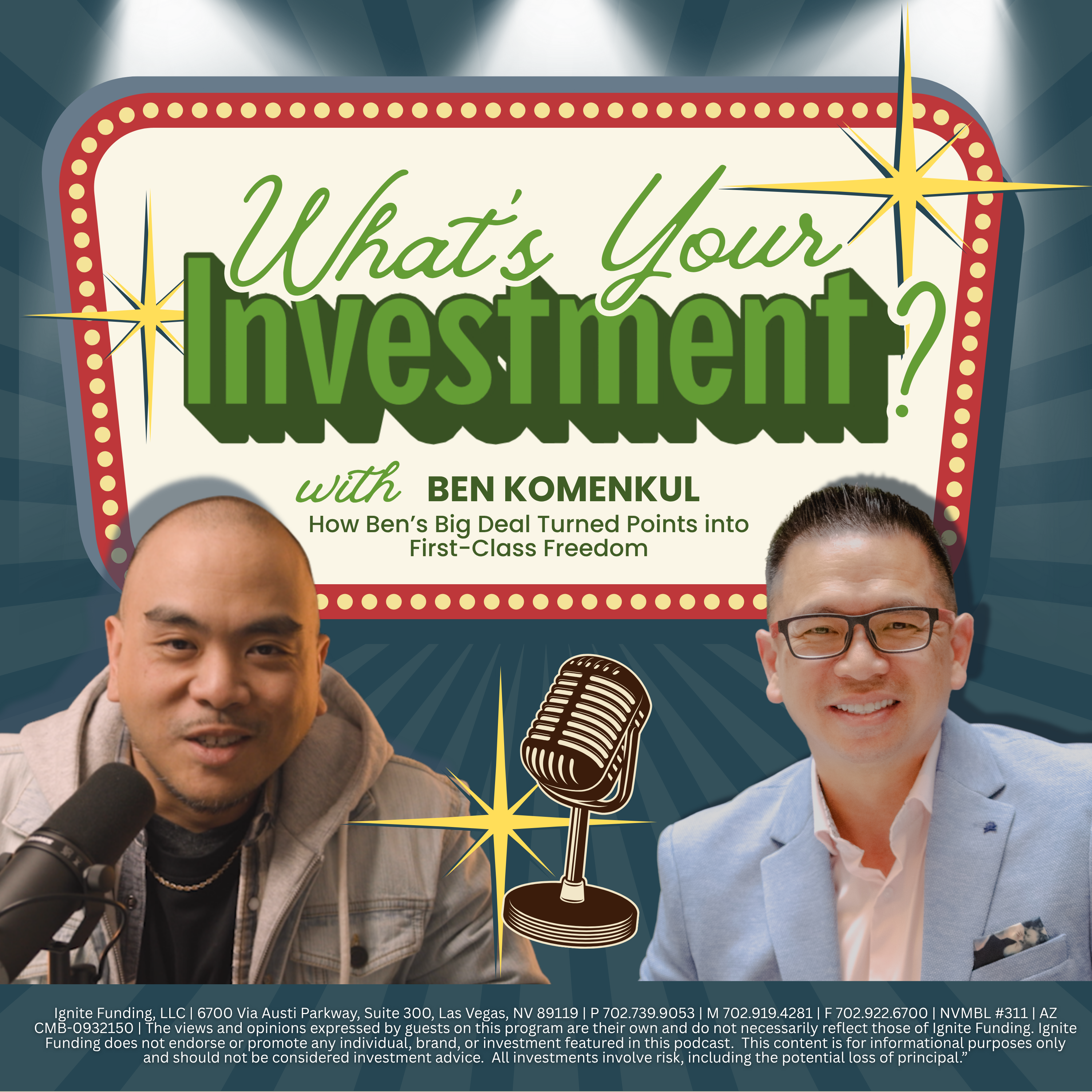
[00:00:00] Speaker A: Welcome to the what's yous Investment Podcast presented by Ignite Funding with Ron Arceo with featured guests. Weekly podcasts that explore your time, talent and treasure like share and follow. For more what's your Investment? Let's get to the show.
[00:00:16] Speaker B: Hey, what's up, Ronald Arceo here for the what's yous Investment series. In this episode, we're talking to Ben Komenko. Ben's a luxury travel coach, credit card strategist, and founder again of Ben's Big Deal, where he helps families, entrepreneurs, business travelers, people of all different areas of life turn their spending, pretty much their everyday spending into unforgettable experiences. So not only experiences, you say, first class adventures.
Tell me a little bit about that when we'll get to a little bit about your journey where you began in 1989.
But tell me before we get into it, tell me a little bit about what first class adventures actually mean.
[00:00:59] Speaker C: Ben well, you know, I, I teach business owners and real estate investors all the time how to travel better using the same mindset that they already use to grow wealth.
So I try to show them what they can actually do with the work that they're already doing it, but make that money that they're working and they're working with work harder for them. So, so think about it this way. Let's say, for example, in real estate, you already use leverage. You might buy a property with 20% down, you may use the bank's money to build equity, or maybe you're buying that luxury SUV because it qualifies like a business deduction. And instead of saying money to Uncle Sam. So what I kind of do is I help you do the same thing like when the same type of leverage, but with your everyday spending. So instead of sending your money to airlines, hotel, when you want to take a vacation, you can use the right credit card, their program so that every renovation you make, every marketing dollar, every property tax payment that starts earning you points for first class travel, for luxury hotel stays, and without having to spend extra dollars every single day. So it's like discovering now that your business expenses now doubles like your next family vacation fund. So, for example, now you can now take a trip, big business class to Europe rather than just using coach to Miami.
[00:02:19] Speaker B: Yeah, so, so you said you basically could take a lot of different ways to make more effective the dollar that you're spending.
So you began in 1999, right?
You, I remember you telling me on the last call that we had that you kind of didn't know what airport lounges were and you're kind of just traveling back and forth.
And so when you got into that, how did you discover this whole air airline lounge thing? Like, what was, what was going on then in your life at that time in terms of what you're traveling for?
[00:02:57] Speaker C: So I always wanted to travel. I remember when I was a little kid and we would go to the airport and people used to dress up to go to airports. But I remember when I was a little kid, I just like, man, I totally wish I jumped in that little suitcase they always talk about and fly with them. You know, here's the thing. I, I think most people at one point would like to discover more than just beyond five miles from their house. And I really felt like there was kind of really difficult to be able to do that. So when I was able to find a job finally that was allowing me or paying me to, to travel, I was so excited. And I think for the first five years I did what most people do, which is they look for the lowest cost flight. They look for, you know, they think all airlines are all the same. And it took me actually about five years before I really realized I was doing it wrong. And I don't think a lot of people realize that sometimes, even as a business traveler, you maybe know your airline, you know your route, you know the hotel that you stay at, you know your city, and you kind of get into rhythm. And then you realize that there's other ways out there to do it, other people are doing other ways. And the best way that I can probably share this is I was one time, I was sitting, I went, see, this is the kind of person I am. I get on a plane and I would, I kid you not, I would actually get on and I would look to the people on the left and right when I'm crossing through first class on my way to my economy seat, I'd like, these people are idiots. Why are they paying for first class? When we're going to get to the, when we're going to get to the same city at the same time, maybe there's 20ft ahead of me. Here's the thing. What I didn't know, here's what I didn't realize. I didn't realize that probably 80% of those people up front were getting upgraded for free.
And that was a big, like my. And how I realized that was I was sitting in that extra legroom section, which I probably paid for because I didn't know anything about status. And I was sitting next to the guy and the flight, the, the the gate agent came up right before we took off, came up and told the gentleman, are you so and so? And they said yes. And then they handed him a new airplane ticket and they took their old one and they said, you can grab your stuff and move up to the front of the plane. And I said to myself, bro, I've been flying this airline for three years, three, four years, and I never seen that happened. I talked to the guy later as we were getting off the plane, and he tells me he flies this airline all the time. And I knew from our conversation he flew less than me. So the dude flew less than me, but got upgraded. I said I was doing something wrong.
Huh.
[00:05:21] Speaker B: So. So let me. Let me backtrack. So you were traveling. You were just. Just travel. To travel the industry that you're in, just so people know you. You were in the fight in the. In the insurance agency, in the insurance industry for what, 25 years?
[00:05:36] Speaker C: 25 years, at least at the time. Y.
Yeah.
[00:05:39] Speaker B: And then you got into this whole traveling thing and then just started realizing, like, oh, people are probably going to be probably spending more money to go on first class and business class. At least that's what you thought, right? And then through conversation, I suppose you were talking to a few people that. That you. You. That they announced, I guess, that they. They travel less than you, and yet they got more of the perks.
Um, how did that feel at that time?
[00:06:07] Speaker C: I didn't. I didn't understand. But here's the reason why I say that. What I looked at, how I booked was different because he was booking it strictly with one airline because he knew he was going to get a benefit, like free bags, like free check in, you know, lounge access when he's flying internationally. All these nice perks, which I didn't get because I was looking for the least expensive ticket. I was flying Southwest when it was locally. When it was across the country, I flying American. If I'm going to Pacific Northwest, I'm flying Alaska. So I ended up not having points with any airline that was significant up to make a redemption. So I never got a free flight, even though I was flying them twice a month. And then on top of that, I never earned any VIP status with them because they said, you don't fly enough. And it wasn't true, but it's just spreading it out across.
So some. Some of us, we called it. Nowadays, we call that being a free agent. And so I want to share with you that although sounds like being a free agent is the best because you're getting the lowest price ticket. You're really not. Because every time you get on a plane, guess what? If you don't have any VIP status or elite status, you're paying for an extra bag. You're paying for a seat selection. Like even if you're sitting in the back of the plane, they're charging you to sit with your family.
They're charging you if you want an aisle seat. They know if you like window, they're going to charge you for that. They know if you want extra legroom, they're going to charge you for that. I mean, even Southwest, who has always been kind of like, pick your own seats. They moving. They're moving now. They're putting extra legroom seats, which means that they're going to have seats that went from 32 inch pitch to 30 inch pitch. So you're going to lose 2 inches in Southwest starting next year.
[00:07:43] Speaker B: Interesting. You know, I, I flew Frontier.
[00:07:49] Speaker C: And.
[00:07:49] Speaker B: They had, they had some pretty good programs actually. I don't normally, I don't normally look at their credit programs or they're just flying their flight programs and rewards programs. It's pretty cool.
So when you're flying, so you were flying less, they were getting more, more bang for their buck, so to speak.
What, what got you to the point where, you know, you, you started earning that elite stat? Like what, what made the switch? What was the original kind of catalyst or moment that made you decide like, I gotta go do this?
[00:08:27] Speaker C: You know, as some gentlemen who are watching this will probably hear this, I didn't really, super really care where I stayed at. I just needed a place to stay.
And then I remember we had a hotel program budget. Our budget was you could stay any hotel you want as long as the name of the hotel has a word in, in the name, that's residence in quality in holiday innings you wanted. And I remember staying at the, at the La Quinta. There we go. La Quinta Inn. The La Quinta Inn. Now, if anyone ever stayed La Quinta Inn, it's not five star whatsoever. In fact, all the inns are probably more like a two, two and a half star at best.
And I remember getting excited because I had got to top tier black level status. I had like 30 nights with La Quinta and they gave me two free nights. I told my wife, hey, I'm going to take you on a vacation in San Diego. She's thinking like, it's going to be sand and surf. It's going to be exciting. Well, when we pulled up to our La Quinta Hotel, which was off the Hotel circle, off the 8 freeway. And she. Her view was not at the beach, and it was the parking lot. She was kind of like, what. What are you doing? Like, why are you taking me here? What is it, a vacation?
Exactly. You know, because here's the thing. And. And I think this is really important.
[00:09:43] Speaker B: Thanks, by the way. I'm gonna use this, by the way.
[00:09:47] Speaker C: Like, points and miles is not just about free vacation. I didn't get that at the beginning, what it is. And I think this is what my wife kind of taught me, that whole interaction, because she told me at the end of it, she's like, you know what? After we had our free breakfast there at that. At that hotel.
And remember, this is that free breakfast where you're like, you know, it's the plastic Plexiglas, has the bread in the little Plexiglass you're pulling out of the drawer. That type of breakfast. It's not like a buffet, like, you know, some Las Vegas buffet type of style. It is like a very basic breakfast. And when she. We were done, she told me. She's like, ben, if this is your idea of a vacation, I'm not interested in going any more vacations with you. She's like, I'd rather stay home. It's more comfortable. You know, I get to sleep. You know, that was. You know, it. It's those type of things that must have been.
[00:10:36] Speaker B: Well, yeah, explain. That was those. That thing, that kind of.
[00:10:39] Speaker C: What it was, that situation that made me realize, you know what? Maybe I need to switch jobs. I need to find a better travel policy. Because this is not impressing my wife. Because, see, when I got started, in points of. In the back of my mind, I think every consultant, business traveler always thinks it's like, ooh, this will help fund my personal vacations. I'll have free nights to do that. But if you don't choose the right hotel program, you know, I was telling someone else, choosing the right hotel program is like choosing the right sports team. You don't choose the right sports team, you're never going to win a championship. You know? You know, I know, you know, New York Giant, you know, New York jets fans or Cleveland Brown. You're never winning a Super bowl, you know, it's not going to happen. And part of it is the same thing when it comes to airlines, when it comes to hotels. So I ended up switching over to Hyatt. I had spent a lot of different hotels, but I remember when I first switched and I got a new job. I was like, wow, Hilton's great. Oh, Marriott's great. Oh, IHG is great. Everything was better than La Quinta. And so I never want to go back. Like, I never want to go back. So I'll start off with that caveat. But I realized over time that not all hotel points were created equal. Like a $300 night at a, at a Hilton, $300 night would cost 45,000 points.
Marriott would charge 30,000 points, but Hyatt would charge 15,000 points. So I was like, okay, so if I had the same number of points, I can get three nights what Hilton was going to charge me. So I started going down that road and I found out that Hyatt was a better program for what I was trying to do. Now if I like to do roads, they didn't have as many as, as Merit and Hilton. But when I did get there, they're really nice. So I would recommend that program for a lot of people who are first getting started with points and miles.
[00:12:27] Speaker B: So super cool stuff. I think people, because we have, we have, I have staff here that are probably going to be listening into this and they have to travel some, some, many of the times probably wishing they heard this previous to their last purchase of airline tickets.
[00:12:42] Speaker C: It's never too late. It's never too late.
[00:12:46] Speaker B: So, okay, cool. So you got these points. You got, you start for the viewers or for the listeners, give them a little bit of background. How many places have you stayed in, like just over this past, just general ballpark number. I'm sure it's a lot, like to kind of get all this data, like over the years.
[00:13:07] Speaker C: I've been a business traveler now for about 15 years. On average, I'm flying probably about a hundred thousand plus miles a year.
I'll probably stay about 75 to 100 hotel nights a year, generally speaking.
Now here's the thing. What I don't want people to think is that, oh, I can't do that. I don't do that. Here's what I want to let you know. You don't need to do that. For example, if you wanted to earn points and miles, you don't need to actually travel a lot. Nowadays, especially after the pandemic, many of the hotel programs and the airlines programs understand that. And I want to kind of start one, one step back. Even before then, the hotel and the airline programs create these loyalty programs. They use that to kind of incentivize you to come back.
The number one buyer of miles is not you and me. Because think about when was the last time you actually paid money for a mile. You don't. That's actually being bought by the bank, the bank that they work with. So, for example, American Airlines works with Citi, Chase works with Chase works with Hyatt and Marriott.
Delta, Delta and Hilton work with American Express. So they all, whether it's an airline or hotel, they all have an exclusive banking relationship. And those banks that they have relationship with are buying the miles on behalf of us. So here's how the process work. Those airlines and hotels are selling the miles to the banks. The banks are offering us the credit card. So every time we swipe our card, we're earning points every time we swipe our card. So whether you're paying your property tax or you're buying something, you can be earning miles and points. But here's the thing. Not all miles and points are worth the same. They're worth different.
So I actually even have a chart, like a pyramid. But I'll give you an example.
I'll give you example of this.
Delta is a very popular program that people come to me all the time, say I have all these Delta miles, okay? And because Delta is a premium airline, or Delta presents itself as a premium airline, okay? And I'm not saying they don't. They do.
And so because they are their points, they're going to charge more for their flights, okay, Sometimes double what American is charging on points. So just, just from simple economics, if you were earning American airline miles, you could get double the number of flights. You can get two tickets for what, what Delta would charge for one ticket. So although you like Delta, you, you, if you're trying to bring a family of four, anybody's listening, out of family.
Delta is probably not the program that you want to earn if you're trying to, you know, get your entire family from point A to point B somewhere. I would say American's a better program for that. And I would say that anyone in my poison miles space would all 100% agree how that works.
[00:16:02] Speaker B: Awesome. Perfect segue because you have been teaching this to many different people across a pretty long time. How long have you been. Have you been.
[00:16:13] Speaker C: I've been. I have been teaching about points miles now since 2016. I grew this one Facebook group from like a thousand to like 40,000. And now I teach a more of a private group session now we call our master classes that I teach every week.
[00:16:30] Speaker B: And just so people can kind of get a, get a figuring of what this is.
It's. It's Ben's signature live masterclass it's called Hotel Secrets and Airline Points Academy.
He's been helping thousands of pretty much his students kind of crack that code on the points, on the miles, on the upgrades, on insider travel perks. I mean like to be traveling. I mean, I'm sure a lot of people travel as much as Ben, but I don't think they don't think they go into this granular enough detail of who I mean. Did you know that banks actually worked? Well, obviously you do because you got the credit card, but did you know that the banks actually work in tandem with these folks? That's a. Ben's been dropping a couple of gems here. So I want to say thank you for that. I appreciate that. It's not all the time that someone can come in and kind of coach others.
And being kind of a travel coach, people don't even realize like that having an understanding of the system around the financial system, around how these things work is super interesting.
I'm assuming your insurance background kind of informed this a bit. Kind of inform this idea of being disciplined and disciplined in the finances that you're utilizing for building the wealth.
[00:17:50] Speaker C: I would say, I would say for 25 to 30 years what I've been doing is helping people protect their family with insurance, life insurance, making sure they save for retirement, making sure they have the emergency fund, their college education.
These are things are all what I would call long term goals. Right. But I would say that nowadays what I do is kind of 2.0 and financial planning. What I consider what is today.
Today, financial planning meaning like the next 12 months I want to go on a vacation and more. For most people who ignore this, that they're so good at planning for the future, but they're not that great at figuring out that there's other currencies out there that can be able to fund their vacation. And I'm here to kind of share people that if you took a little time to do that, it's actually pretty fun.
I would almost say for some people it's kind of addicting. It's kind of their hobby. I have a lot of people who are retired as well. Like this is like their new hobby is to learn about how point strategies can be able to turn their everyday expenses literally into their next first classification. Because this is the way I look at, this is the way I look at points. It's like gifting, when you give someone a good gift is like you give them something that they normally would not buy with their own cash. So that's the way I look at points as well, I could go buy an economy ticket. In fact, I would say this. Most of the time when I buy economy ticket, even to this day, I'll usually pay with the cash. But if I'm getting up to the higher ends where like let's say I want to go to Thailand, like I'm running a group trip to Thailand in January.
If I had people who want to fly economy, I say if you're going to fly economy, it's like you know, six hundred to a thousand bucks. You can get it done, you know, end of story. But once we they say, well, I want more comfortable premium economy business class, well that starts jumping up to 2,000 to 5,000. At 2 to 5,000, I don't know if you want to take your hard earned cash and spend that amount. But for just double the points instead of 35,000 now you're spending 70,000 points. Only double points.
You can be able to actually fly business class now. So 70,000 points now instead of getting $0.01 per point using how most people redeem them, now you're getting 4 cents per point. So now you're turning what would have been an economy ticket now into a business class ticket. And so I show people how to be able to do that each and every day.
[00:20:12] Speaker B: Love it. That's cool. That's awesome.
When you guys get in touch with Ben, tell him we sent you and tell them we want to get on a group trip too.
So. So I saw a lot of accolades. I saw you've been featured on U.S. news World Report. Yeah, I got some notes of your ABC News, Spectrum News, Inside Edition, Nerd Wallet.
You've also been on looks like you travel conferences. I didn't even know there, there, there were such things.
You may have to fill me in on what some of these are. Zork Fest, Travel Morcon, Frequent Traveler University, and then a bunch of I'm assuming Chicago seminars is also a travel conference.
[00:21:00] Speaker C: That'S coming, that's coming actually up in a couple of weeks. I'm speaking of that as well. So like all the best points and miles travel. This is the thing. There's travel agents out there who book cash tickets all the time. Many of them come actually take class with me because they want to help their clients. Also help them with the points because sometimes clients are like, okay, yeah, I want to, I want to take my entire family. But I got all these points too. Can you help me with that? And if you're a travel advisor and you can't help them because you only Book cash tickets. You could be able also learn how to do this. Help your clients. Well either charge them a fee to do it or if you want to make it a value add. I actually have quite a bit of travel agents. Come take classes with me on this part.
[00:21:36] Speaker B: Fun. Interesting, interesting. So what were, what were some of those being featured on these areas and speaking. What's that been like over the last. You've been doing this since 2016. It's now 10 years later, just about.
You've amassed a big following.
What, what's the, what's the one takeaway, I guess you could say if you were to look back to your 2016 self to today. What's the, what's the biggest, most proudest, most awesomest thing that you could say that you've, that you've experienced so far?
[00:22:14] Speaker C: I mean there's a few things. One is I love the aha moment with someone when they realize like their life is going to change. Like for many people travel is not just the logistic of getting point A to point B. For them, travel is an escape from the stress of life to be in a new environment. For my daughter, when I take her to a new place, travel has been a classroom. We were in San Sebastian in Spain and we were able to take a father daughter trip. I had a friend of mine who was in a divorce and he was taking his daughter when she turned 16 somewhere. He said pick anywhere we go. So he took his daughter to Paris and he told the younger one when she turned 16 she could do that. They do the same father daughter trip. I thought to myself, why do I have to wait till my daughter turns 16 to do this? We should do this now. So when she was only like, I think like six years old, I took my daughter to the big island. My wife was going on it by the way. It was hard to convince my wife that it was that I should go take my 5 year daughter just on a father daughter trip without her. But she was going somewhere on a work trip herself. And so when I said, well when you go work, that's when I'm taking her because you have to leave her with me anyway, so might as well let's go to a nice hotel. So I took my daughter to the big island and I'll tell you, from the time that we got on the plane, the flight attendants were kind of like, oh, is mom joining us? And I'm like no, this is a father daughter trip. They loved it. They were like, wow, this is so cool because I think every girl Needs to spend more time with their dad. I think there's so many things, you know, like moms are very nurturing, but I think dads give their kids confidence, you know, yeah, you can do it. It's okay. Get up and do it again. Dads are so important. And I feel like as a father, the best thing about the travel piece of it has been the amount of time I've been able to spend time, not only my daughter, when we get away, because, you know, the reality is this, when you're at home, you're busy, you have your thing, they have their thing. But when you're traveling, you're in a new environment, you need to be completely aware of your surroundings, and so you. Your family. I'm, like, in a different mode when I travel, and I love it. I look back at the pictures, and the pictures and videos I have are probably my most memorable asset I have of all the places that we've been. But it's not just like, ooh, it was cool there, but it was that we got to spend time together. And anybody who's listening right now, if you think, you know what, I don't have time to travel. I need to go build my business. Listen, you go ask yourself again, why are you doing this business? It's not just to go make money, because after a while, you can go make money anytime. But the time and the memories that we have with our loved ones, those are fleeting. You never know how long that's going to be again. And sometimes the only way to do that is if you get away.
[00:24:58] Speaker B: Love that.
I'm going to take that home with me.
Another question along that side. So let's say you have.
Let's say your wife was on a trip, and then you brought your daughter along, and it was kind of like, oh, you gotta come. Come through anyway. So let's say you're. You're. You have. You have family members that maybe don't necessarily believe in the traveling thing or believing in what you say, or maybe they're. They're trying to, but they just don't see a way out. Because maybe let's just say time, money, and then we'll get to a few of those other things. But like, what do you say about those. Those folks that may say, I don't have the money or I don't have the time, or maybe this isn't the right.
Not the right time for me. How. How can they start looking at it? I know we were talking about points, but this is very related, right? I mean, like how can they experience more of their presence with their families and their friends and their loved ones if, if, if they're already making kind of these excuses and I'm not calling these people, they're making an excuse. I'm just saying that because we, we all have challenging times and we all got to make time for these things, right? So how do you, how would you balance that? What would you say to, to that?
[00:26:15] Speaker C: You know, I, I would say that many of us don't have time for things. We make time for the things are important to us. And I know whenever my wife and I still remember every single time my wife and my daughter left me like, and you know, they had go on a trip and I'm just by myself, I always look back and I go, I don't like this feeling like I want to have my family with me when I'm going somewhere or I'm doing something. And I think one of those things is when, when we take time for granted. You can always go make more money, you can always go make more money, but you can't make time. And I think time is a fleeting thing. And I think I want to explain or share this with someone because if you've ever lost someone who's close, if you've ever lost that opportunity to do again, like sometimes you think, you know what, I can't go with you to Thailand this year, I'll do it next year. Next year may not come next year, may, may be something else. And it does push. I. Last year when I went to Thailand, I led my group trip. I took My buddy of 25 years, I've known him since it was college, he went with me on this trip.
It was a 25 year trip in the making. We had been talking about it for years, brother. I mean it's on for years and it was a never. Because career got in the way, timing got in the way, work got in the way, so many things. And because of that it never happened. And I was so fortunate at least to complete and wrap up that cycle. But I want to share with you, every one of you who's listening to this. There's an excuse you can make, but there's also a way out. If you're saying, you know what, then my credit is no good, well then let's go use get good credit. Because you know, if you're good, if you have good credit in this country, you can do anything. You can buy places, you can get, you can get your home for cheaper, you can get your car for Less you can go on vacations, but I'll teach you how to go do that for free. And you're like, no, they cannot be. Yes. People who have good credit do it all the time. You're like, I know there's people online who are like, you don't get, like Dave Ramsey, like, you don't get. No, there's no millionaire. Look, you're not a millionaire. And therefore, let's go figure out how you can get on that trip for free. I mean, that's the reality.
And even if you're a millionaire, by the way, billionaires didn't become millionaires because they spend their money unwisely. They're smart about it. If loyalty programs exist and they're there to help you earn your points and so that you could be able to retire or I'm sorry, so that you could be able to enjoy that trip faster, you should do it. Why not do it? And the only reason people don't do it is because they're sometimes they're complicated. That's the reason why I put the course together to kind of demystify it. I do a four day course and I'm like, look, in four days you can be able to understand everything you do to make your first redemptions. Like for example, one mistake I see a lot of people do is they go and get a first. They get their first credit card. They don't plan, they just earn. They go, I'm going to earn. And then they come back and they go up, Ben, how do I, what if I do these Delta Miles and these Marriott points instead? I would rather say, look, where do you want to go? Oh, I want to take my family to Japan. But they're guessing because they think all the points are the same. I would say, well, then let's put a plan together. Let's earn the right points to get your family afford to Japan and let's get, you know, a hotel for them. So now that you, you got, now you're strategically getting the right points for the trip you're trying to get and there's no more guesswork. You absolutely know I have the points I need. I've been advised by someone who knows what they're doing and next thing you know, you're on that trip and you go, wow, this works. Most people, they don't. They, they have like a square, a square round circle and a square peg and it doesn't work. And they're trying to figure out like, why doesn't it work? Because you got the wrong points.
[00:29:54] Speaker B: Yeah. And, you know, I'm very thankful that I get a chance to be talking to you, because a lot of times people that just don't know, you know, they may not have an idea that there's differences in points and differences in the companies you work with and differences with the.
[00:30:09] Speaker C: With the.
[00:30:09] Speaker B: The type of airlines or the hotels that you're staying in. Like, there's. There's differences.
So let's say someone new is coming into your program.
What can they look forward to?
[00:30:23] Speaker C: Well, if they're like, I'm. I'm running my hotel masterclass this week. One of the reasons I've asked a lot of students what do they hope to gain from the course? Because I want to know when I. When I'm done. Everyone has a very specific goal. Her goal was, she said, you know what? I want to be able to understand how I can be able to get upgraded for free. Like, I see a lot of your students get upgraded for free. Like, how does that work? I have gotten the right credit cards, and she's been doing this for two years. Okay. My average student is not, like, brand new. They're like.
Because what happens is a lot of the stuff that you get on Instagram or on YouTube is geared toward a very broad audience. Why? Because they want to get as many people to consume it as possible. But once you get to that point, you, okay, you watch the videos, you're kind of going, I can't get to the next level. I can't get to step two, step three. And so they're trying to understand how do they. Does elite status make sense? Do they need to go get these things done?
I always want to make sure that when I'm talking to someone that their goals are met. I may tell them, you don't need Southwest companion pass. Why? How many times are you using it? So I may question some of the things that they've done, because I want to make sure that their complete focus is on whatever their goal would be. So if they need to get. For example, if you want to go to Japan, okay, if you want to go to Japan, American Airlines has a relationship with Japan Airlines. So you can actually use. Here.
You can use your American Airline miles to fly Japan Airlines. Because that's the thing. Sometimes people are like, well, I don't want to fly Japan Airlines. You don't. I'm sorry, I don't want to fly American Airlines. You don't have to fly American Airlines to earn American miles. You can actually get their credit card. You can use their shopping Portal, you can have a dining program. Like if you eat out every time, you should be earning anywhere with your credit card, you should be earning, not 3x4x. You should be earning 8x to 9x. Like my students earn 8 to 9x back on every single meal that when they go and they go and eat every time they're doing online shopping, like Lululemon, for example, they should be going through a shopping portal or they should, they should be earning. So like my people are earning five times faster than the average person. So because sometimes you're like, well, how do they earn so many points? They must spend a lot. No, they spend the same amount, but because they know how to do it, they're earning five times more than you are. And therefore they can get their whole family, where you can only get one person, they're getting a whole family of five.
Love it. Love it.
[00:32:47] Speaker B: Yeah, I mean like different, different influencers out there in the financial space, obviously, for different reasons. Different, different concepts and the logos of it.
[00:32:56] Speaker C: Right.
[00:32:57] Speaker B: But really for this podcast, what's your investment?
It really, we're really about understanding where people are on their journey in terms of the influencer at least, and, and how they got all started. My whole goal for this investment podcast, or not even investment podcast, I don't even know what you would call this an investment podcast. This is, this is a get to know you podcast.
But it is for, for people that want to find different avenues of, of either being wise in their financial decisions, trying to be smarter in their financial decisions, trying to understand and learn more.
Having someone here on this call that's been doing this for over 10 years and teaching, I would say for over 10 years, but then been doing this for what, 20 something plus years at this point, and helping others. You said you went from a thousand to a 40,000 group. I mean that's, that's a big deal. And for, and people don't just do that out of nowhere. People have to earn that, in my opinion. And Ben's definitely earned it. So for people that are here, what do you invest your time in? What are some things that you invest your time in?
[00:34:09] Speaker C: I mean, I invest my time in, obviously it's discovering new things. I think that those are the thing. I am totally enjoying the time I had with my daughter when she started, when she was born. I think I was just in the first stages of it. I have an older daughter now who's actually 26. And I look at how we've changed our travel so much from the time we were with my older daughter, where we were doing more domestic trips. And now my younger daughter's probably been to like 18 countries now in the last few years. And she's had a different world perspective. She's much more. She understands now that her life is not just Los Angeles. Like we were thinking about planning to move to Mexico this past year and she was all ready for it. She's ready to learn a new language. She was ready to learn to have new friends.
And these are the things I think, you know, the journey for me has been the process of discovery. For me it's, you know, travel has pretty much become not only my work now, but also which is a hobby for a long, long time. Before I ever made a dime doing this, I remember my wife was like, I was, remember when I was building that group, it was for fun. I loved it. I helped everybody under the sun. And my wife, I think came to me one day, she says, you know, this is enough. You can't do this anymore. This is way too much time. It's not enough time with the family.
So I came back to her, I said, okay, if I can make this hobby into a business, a part time business, would you go along with it? So she went along with that part of it. And I think she thought, in my mind, she's like, no, he's not going to turn it into anything. And I remember the very first month I did this, I made like $15,000 part time doing this. And three months later I decided to quit my job and go and do this full time. And it's been great. Like any entrepreneur, you have your ups and downs, but I realized you can be able to do something if you really love it, if you really passionate about it. So I didn't start this off as, as like I'm here to go make money. I did it because I love doing it. I did this business for six years, six years, never made a dime doing it. And I have, you know, the community of points Miles. There's an entire community of it. They know me from that during those six years. So when I start started do this, I got a lot of love from the group just because they knew that I really loved doing it. And honestly, if I didn't monetize it, my wife wouldn't let me do this anymore.
[00:36:40] Speaker B: So almost you kind of had to, right? You had to like find a way.
[00:36:43] Speaker C: I had to go down this road because it was other that then just stop. And I'm like, how many people can you help along the way? I love Helping. And I feel like now I've had, you know, at least a thousand students go through in the last couple years where I personally coached and mentored. And now they're doing Bora Bora. Now they're getting upgraded the park hike, Kyoto. I mean, they're going in there with base points and they're coming out when I, when they're leaving, staying at hotels, rooms that are named hotel rooms. Like they're not just executive suite. It's like the, no Shimura suite. You know, it's like the house. Like they're coming out of places that are like $12,000 a night hotel that I'm showing them how to get for free.
[00:37:22] Speaker B: Wild. Wild.
Man, I'm, I'm so excited. Like, I don't even know if I'm going to do, like, I don't even know where I'm going to go. But I'm like thinking like, where can I go now? I'm not even thinking about how. Right. Because kind of like what you're saying, right?
[00:37:35] Speaker C: Yeah. You know, I've had clients who usually are used to paying cash, 15 to 20,000, take their whole family, Italy for a whole Italy vacation. And they're trying to cram everything in. And I said, look, now that you're earning points, it's not a once in a lifetime trip. Nothing is once in a lifetime. Everything is possible to come back again. And I think that part of it, I feel so excited. And it blows her mind to go, you're right, I can do this again. I don't have to try to cram in 15 different things and not really enjoy the time because you think it's a once in a lifetime, you're ever going to do this again. So I have changed people's travel habits from maybe once or twice a year now. Now they're traveling eight to nine times a year.
Wow.
[00:38:12] Speaker B: Amazing. That's pretty cool.
I'm pretty sure I have friends that follow you probably because I see them, I see, I know they travel. And if you're watching this, I know you watch them so cool. So you invest your time in family.
What do you invest your talent? Do you. Do you invest your talents in. Do you what, what talents do you have and do you invest in them at all?
[00:38:35] Speaker C: You know, one, one thing I did is I love sharing our culture. Being Thai, I. My father came this country back in 1977 when the first ties first originally came here to America. Really? I don't even know that there was no Thai immigration prior to 65 at all. Because there was a, the, the exemption act, the Chinese immigration. So there was no Asian immigration. I think the only ones who were here were the Filipinos come in. Because, you know, because McCarthy, because of the war, World War II. So they were able to come, but there was no Asian, Southeast Asian immigration whatsoever. So my dad came here, he totally missed Thai food. And he's like, I'm going to open up a thai restaurant.
In 1972, he opened up new because he loved noodles. See, in Thailand around the late 50s, there was a noodle, there was a rice shortage, there was a drought, so there's a rice shortage. So the government was really big on noodles. Like, they wanted rice noodles. And the prime minister at the time actually made a contest. They said, we need to promote rice noodles around the world and they want to do export and what. And so they came up with this contest of like, what is the best noodle dish? And came up with, and the winner created something called Pot Thai.
[00:39:49] Speaker B: Awesome. Awesome. Well, I mean, that's, that's, that's, that's, I mean, it takes, it takes time to really invest in family, to invest in town takes some time too. I mean, you got to know what you like. You got to know what you don't like.
I got one last final question. What do you invest your treasure in?
You could talk about money. You could talk about, you don't have to talk about money at all. You could just talk about what's what, what's most dear to your heart, I.
[00:40:14] Speaker C: Guess, you know, I, I, I, I'm gonna, I'm gonna say this.
I find that nowadays. There's a big talk nowadays about education.
Like we don't need to go to school because it's a waste of money. I think we don't need to go to school because you can learn the things of the school. Hard knocks. I, I hear what that conversation is, but at the same time, I also think that it doesn't tell the whole story of what education is. When my daughter was during the pandemic and even post pandemic, we did homeschool. If we want to go with, can she learn more at homeschool than she can in school? The answer is yes, absolutely. Do you need to go to college to learn? No, you do not. So the answer is that. But is that what college is about? Is that what education is about? Because the one thing she missed out was the social interaction, the ability to understand people. And I want to kind of lead it to this point where I think a lot of things that people Realize or don't realize is that you lose out on the social aspect. And the social aspect is probably one of the most important skills you have. In fact, this is kind of my philosophy with her. I went to USC grade school here in Southern California and I said, nailah, if my philosophy is if she's going to go to a brand name school. And I know a lot of Asian parents want to send their kids to a brand name school, but here's the thing. If you go to a brand name school, you need to network.
If you go to brand name school and you don't meet the people, if you don't go meet the Mark Zuckerbergs while you're there, then why did you even go?
If you're going to Middlebury and you're Kate Middleton and you didn't go and meet the Prince, then why even go like you're there in college? In my opinion, to go network to meet people, to meet the future leaders. So if you're going to go, that's what you need to go do. And if you don't have that social skill, then that's a problem. So I should, you should be going to school right now, anywhere so that you can meet. Because what happens once you graduate from school? You lose all your friends. You're not there anymore, you don't need them anymore. And what do you do? You go to networking events, go make more friends. And if you don't know how to do that, then you're going to be the guy in the wall and you're going waiting for the one person to come talk to you.
So when I say about why school is important, it's because, not because of stuff you're gonna learn in school, but it's because learning about how people and how to interact and get people like you and trust you.
[00:42:45] Speaker B: I love that. I love the fact that you brought it back around to not just education because people do talk a lot about education, people treasuring that. But I agree. I think going to school is one thing when you get knowledge, but then really the network that you build around it.
I always told this to people that after high school you kind of like lose all your friends. Like even after college you kind of lose all your friends and like they.
[00:43:07] Speaker C: Like, who do you go back to?
[00:43:09] Speaker B: And I, I point to my parents, like they don't talk to their friends like from high school. Right. But here, you know, we have that opportunity, especially in today's world with all the technology, we have that opportunity to be educated, become social. I Mean, we're all pretty, you know, we can either do it digitally or we can do it digitally or we can do it in real life.
And there's so many different ways that we can, we can connect with people. So that I think is the treasure, right? The treasure of connection, the treasure of building these experiences with people.
Is there anything for the listeners, one final thing that you'd want them to know you or to know from you to anything. Any final thing that you'd like to say before we get out of here?
[00:43:51] Speaker C: Yeah, I think people, if anything, I appreciate, by the way, I really appreciate time we got to spend. This is a unique conversation. I don't think I always get a chance to share.
But what I do want people to know is that everything that you think is complicated can be learned. Everything that you think you don't have time for, you can make time for if it's important enough for you. And so think about what is important for you. If spending more time with your family is important, then let's figure out a way how to get that done.
And sometimes it requires you go somewhere and sometimes it is more fun because then you get a shared experiences.
Go somewhere new that you haven't done before. Go try a new airline you haven't tried before. Stay at a new property you haven't stayed before. Enjoy a little bit of it and then let me help you kind of take care of the finance piece of it. Because the way I look at in the end is ultimately people spend 90% of their vacation on the cost of the airfare, the travel there, the logistics there, and then where they're going to stay at. If you took all that away, you could be able to take more vacations.
[00:44:56] Speaker B: I guess we'll end it with that.
Thank you, Ben. I appreciate all the time that you spent with us today. It's a good conversation. I think a lot of people got it just a little bit, a little taste of like what you do and how you actually do affect change within the financial space.
So I appreciate you coming on board. On the what's your investment podcast.
People can find
[email protected] I you have, you have your master class Hotel secrets masterclass. You have the airline points Academy. He's all on the socials, either Ben Komenko or Ben's big deal LinkedIn. You may have to find him, but yeah, find him on social, get on his website.
It's been a pleasure, Ben, to be on this call with you and I'll see you on the next round. Hey, thanks for watching the what's yous Investment podcast. Please like follow and comment. And don't forget, check out our other videos. We got the Deeds in the Desert and the Day in the Life episodes. See you there.
[00:45:54] Speaker A: Thank you for tuning in to this episode of what's yous Investment, brought to you by Ignite Funding. Don't forget to like, comment and follow. For more, check out our other podcasts, Deeds in the Desert and let us know who you would like to come onto the show. We'll see you next week.
The views and opinions expressed by guests on this program are their own and do not necessarily reflect those of Ignite Funding. Ignite Funding does not endorse or promote any individual brand or investment featured in this podcast. This content is for informational purposes only and should not be considered investment advice. All investments involve risk, including the potential loss of principal.